
Grade 3 Grammar Worksheet on Antonyms in Sentences

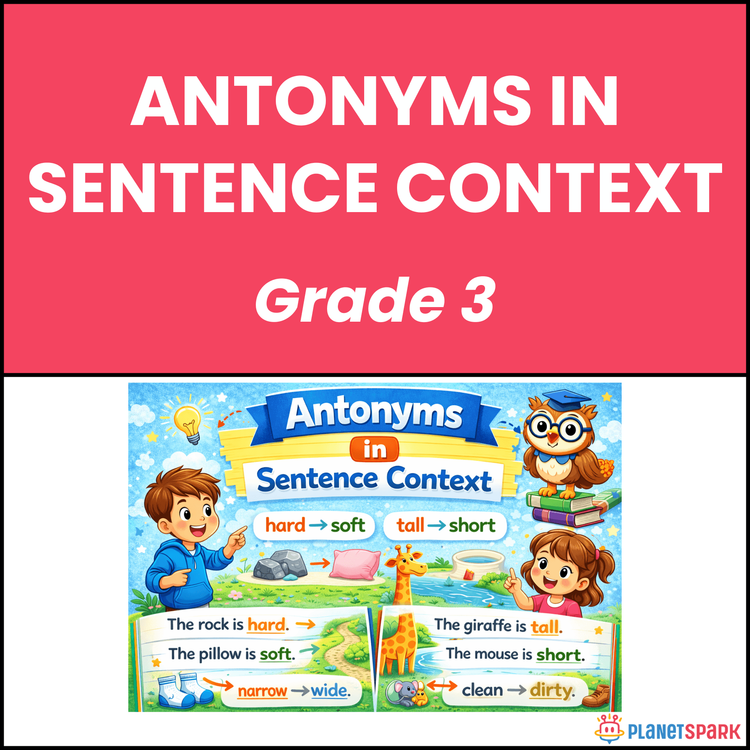
Grade 3 Grammar Worksheet on Antonyms in Sentences
Opposites in Action: Mastering Antonyms in Sentences for Grade 3
This Grade 3 worksheet on Antonyms in Sentence Context helps young learners understand opposite meanings and apply them correctly within sentences. Through structured grammar activities, students learn how to identify, choose, and use antonyms to improve sentence clarity and vocabulary strength.
Why Antonyms Matter in Grammar?
Antonyms are words with opposite meanings. For Grade 3 learners, understanding antonyms is important because:
1. It strengthens vocabulary development.
2. It improves reading comprehension.
3. It builds better sentence construction skills.
4. It helps students understand contrasts in stories and conversations.
What’s Inside This Worksheet?
Exercise 1 – Match the Following
Students match words like hot, big, early, open, and full with their correct opposites such as cold, small, late, close, and empty.
Exercise 2 – Sort the Words
Learners classify word pairs into Antonyms and Not Antonyms to sharpen their understanding of opposite meanings.
Exercise 3 – Fill in the Blanks
Students choose the correct antonym from given pairs to complete meaningful sentences.
Exercise 4 – Multiple Choice Questions
Children read sentence pairs and select the correct opposite word from multiple options.
Exercise 5 – Sentence Rewriting
Students rewrite sentences by replacing underlined words with their correct antonyms.
This worksheet builds logical thinking, strengthens vocabulary, and helps children express contrast clearly in everyday writing.
Answer Key
Exercise 1 – Match the Antonyms
hot – cold
big – small
early – late
happy – sad
open – close
fast – slow
up – down
day – night
full – empty
near – far
Exercise 2 – Sort the Word Pairs
Antonyms:
clean/dirty
young/old
light/heavy
strong/weak
bright/dark
soft/hard
front/back
in/out
Not Antonyms:
sick/ill
rich/wealthy
scared/afraid
huge/big
small/little
quick/fast
start/begin
Exercise 3 – Choose the Correct Antonym
1. dry
2. glad
3. tight
4. quiet
5. empty
6. tiny
7. bright
8. funny
9. straight
10. weak
Exercise 4 – Choose the Correct Option
1. cold
2. short
3. empty
4. bright
5. narrow
6. slowly
7. light
8. dirty
9. quiet
10. wrong
Exercise 5 – Rewrite Using Correct Antonyms
1. The soup tastes bitter today.
2. The movie was interesting.
3. The road is too wide.
4. The baby is awake now.
5. The puzzle was difficult to solve.
6. The cat stayed outside the house.
7. The sky looks clear today.
8. The path seems unsafe to walk.
9. The classroom was noisy.
10. Please leave the door closed at night.
Help your child understand opposites clearly and build a stronger vocabulary foundation today.
Frequently Asked Questions
Antonyms are words with opposite meanings, and they help early learners understand contrast and clarity in Class 3 grammar.
Learning opposites improves comprehension skills and allows children to write more expressive sentences in English worksheets.
Completing a grammar worksheet with matching and sentence-writing tasks helps reinforce opposite word pairs in meaningful contexts.