
Class 2 Countable and Uncountable Nouns Worksheet

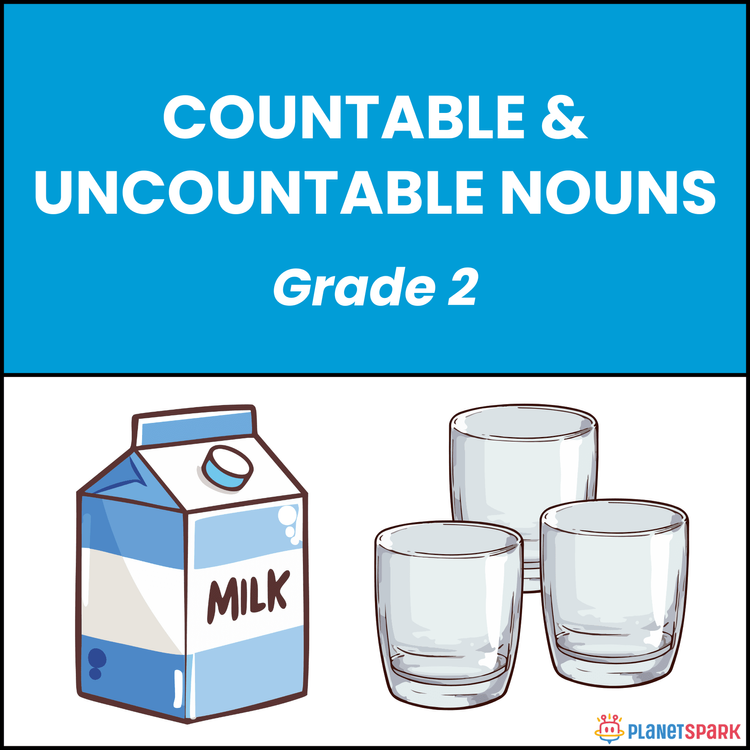
Class 2 Countable and Uncountable Nouns Worksheet
Sorting What We Can Count: Countable & Uncountable Nouns for Class 2
This Grade 2 English grammar worksheet helps young learners clearly understand the difference between countable and uncountable nouns using simple, everyday words. Through familiar examples such as food items, objects, and materials, students learn which nouns can be counted and which ones cannot.
Focused on the topic of Countable & Uncountable Nouns, this worksheet builds grammar understanding step by step. Learners practise identifying noun types through multiple choice questions, filling in blanks using a word bank, matching pictures with the correct noun category, identifying countable and uncountable nouns in sentences, and applying their learning in a short paragraph.
The activities are carefully designed for Class 2 students and use real-life contexts to make grammar learning meaningful and engaging. By working with common nouns used in daily life, students strengthen sentence construction, reading comprehension, and correct word usage.
Why Countable & Uncountable Nouns Matter in Grammar?
Understanding countable and uncountable nouns is important for Grade 2 learners because:
1. It helps children choose correct words while speaking and writing.
2. It improves sentence accuracy and clarity.
3. It supports correct use of numbers and quantities.
4. It builds a strong grammar base for higher-level concepts.
What’s Inside This Worksheet?
This worksheet includes five structured grammar activities designed for Grade 2 learners:
Exercise 1 – Multiple Choice Questions
Students identify whether a given noun is countable or uncountable.
Exercise 2 – Fill in the Blanks
Students complete sentences using suitable countable or uncountable nouns from a word bank.
Exercise 3 – Match the Following
Students match pictures with the correct countable or uncountable noun.
Exercise 4 – Underline and Circle
Students underline the countable noun and circle the uncountable noun in each sentence.
Exercise 5 – Paragraph Fill in the Blanks
Students read a short paragraph and fill in the blanks using appropriate countable and uncountable nouns.
Answer Key (For Parents & Educators)
Exercise 1 – Multiple Choice Questions
1. countable
2. uncountable
3. countable
4. uncountable
5. countable
6. uncountable
7. countable
8. uncountable
9. countable
10. uncountable
Exercise 2 – Fill in the Blanks
1. eggs
2. juice
3. smoke
4. key
5. pillow
6. mud
7. grass
8. apple
9. umbrella
10. coins
Exercise 3 – Match the Following
1. paint → paint
2. bottle → bottle
3. milk → milk
4. juice → juice
5. rain → rain
6. fruit → fruit
7. book → book
8. salt → salt
9. money → money
10. pencils → pencils
Exercise 4 – Underline and Circle
1. Countable: balloon | Uncountable: air
2. Countable: helmet | Uncountable: dust
3. Countable: ball | Uncountable: sand
4. Countable: book
5. Countable: notebook | Uncountable: ink
6. Uncountable: water
7. Countable: bread | Uncountable: milk
8. Uncountable: snow
9. Uncountable: food
10. Countable: fruits
Exercise 5 – Paragraph Fill in the Blanks
Answers may vary.
Strengthen your child’s grammar foundation by helping them confidently identify countable and uncountable nouns through guided practice.
Frequently Asked Questions
Countable nouns can be counted, while uncountable nouns name things that cannot be counted individually.
They may try to count everything unless shown clear examples like water or rice.
It uses visuals and sentence cues to show when counting is possible and when it is not.