
Class 2 Regular Singular and Plural Nouns Worksheet

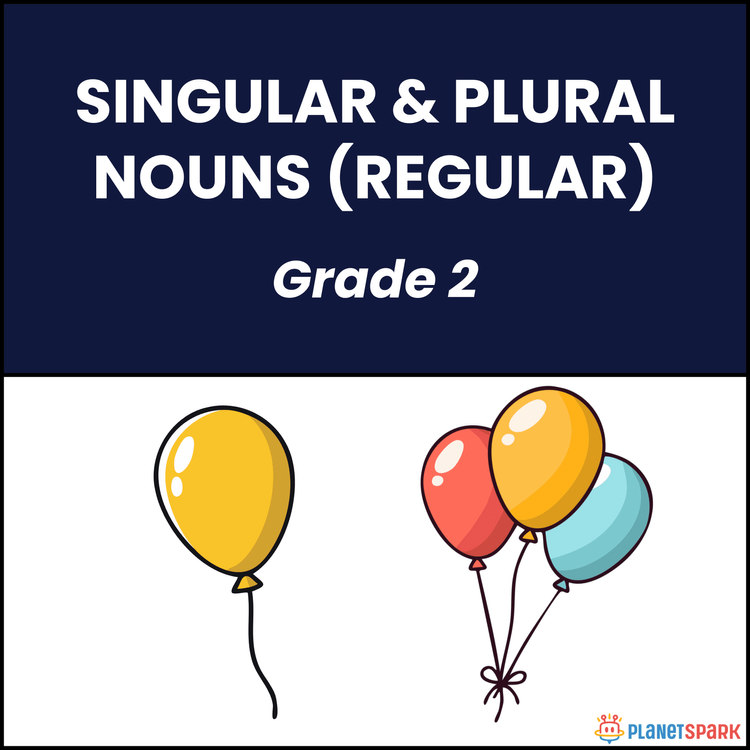
Class 2 Regular Singular and Plural Nouns Worksheet
One or Many at a Glance: Regular Singular & Plural Nouns for Class 2
This Grade 2 English grammar worksheet is designed to help young learners confidently understand and use regular singular and plural nouns. Through simple, familiar vocabulary and real-life sentence examples, students learn how nouns change when talking about one person, animal, place, or thing versus more than one.
Focused on the topic of Singular & Plural Nouns (Regular), this worksheet uses a step-by-step approach to build clarity and accuracy. Learners practise identifying correct noun forms through multiple choice questions, fill-in-the-blanks with a word bank, picture-based matching, identifying singular and plural nouns in sentences, and applying their understanding in a short paragraph.
Each activity is age-appropriate and visually engaging, making grammar learning enjoyable and easy to grasp. By repeatedly seeing nouns used correctly in context, students develop stronger sentence-building skills and improved grammar confidence suitable for Class 2 CBSE English learning.
Why Singular & Plural Nouns Matter in Grammar?
Singular and plural nouns form the foundation of sentence construction for early learners. For Grade 2 students, this topic is important because:
1. It helps children clearly express quantity in sentences.
2. It improves accuracy in reading, writing, and speaking.
3. It strengthens grammar basics needed for higher classes.
4. It supports comprehension by making meaning clearer in stories and passages.
What’s Inside This Worksheet?
This worksheet includes five structured grammar activities designed for Grade 2 learners:
Exercise 1 – Multiple Choice Questions
Students choose the correct singular or plural noun to complete each sentence based on meaning.
Exercise 2 – Fill in the Blanks
Students complete sentences using the correct noun from a word bank, focusing on number agreement.
Exercise 3 – Match the Following
Students match pictures with the correct singular or plural noun, building visual and word recognition.
Exercise 4 – Underline and Circle
Students underline the singular noun and circle the plural noun in each sentence.
Exercise 5 – Paragraph Fill in the Blanks
Students read a short paragraph and fill in the blanks with appropriate singular or plural nouns, applying grammar in context.
Answer Key (For Parents & Educators)
Exercise 1 – Multiple Choice Questions
1. tail 2. bottle 3. kites 4. plate 5. apples
6. swing 7. pencil 8. students 9. shoes 10. ears
Exercise 2 – Fill in the Blanks
1. kites 2. fruit 3. chair 4. book 5. eggs
6. clothes 7. balls 8. bag 9. star 10. cars
Exercise 3 – Match the Following
1. Ball → ball
2. Dogs → dogs
3. Shoes → shoes
4. Candle → candle
5. Pens → pens
6. Pen → pen
7. Glasses → glasses
8. Cat → cat
9. Flowers → flowers
10. Drum → drum
Exercise 4 – Underline and Circle
1. Singular: Pencil | Plural: desks
2. Singular: rabbit | Plural: bushes
3. Singular: girl | Plural: books
4. Singular: monkey | Plural: ladders
5. Singular: car | Plural: houses
6. Singular: boy | Plural: games
7. Singular: bird
8. Plural: teachers, papers
9. Singular: farmer | Plural: cows
10. Singular: puppy | Plural: butterflies
Exercise 5 – Paragraph Fill in the Blanks
dogs, kite, balloons, ducks, squirrel, birds, children
Build strong grammar foundations and help your child master singular and plural nouns with guided, engaging practice.
Frequently Asked Questions
Singular nouns name one person, place, or thing, while plural nouns show more than one and usually add s or es.
Many early learners confuse endings because spelling rules change with sounds like ch, sh, or x.
It gives repeated sentence practice so children learn patterns naturally through use.