
Improve Creative Writing with Story Writing Using Hints
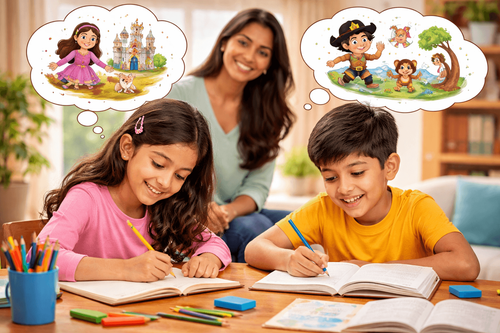

Story writing with hints is one of the easiest and most fun ways for kids to improve their creativity. Instead of starting from a blank page, hints give direction and make writing simple and enjoyable. Many students feel confused about how to begin a story, and that is where story writing hints become very helpful.
This method is especially useful for younger learners, including those practicing story writing with hints for class 5, as it provides structure while still allowing creativity. In this blog, you will learn how to turn simple hints into meaningful stories, see examples, practice exercises, and improve your writing skills step by step.
What is Story Writing with Hints?
Story writing with hints means creating a story using given clues such as words, phrases, or situations. These hints act like a guide and help you organize your thoughts.
Hints can include:
- Words
- Short sentences
- Pictures
- Situations
Example
Hints: boy, forest, lost, dog, help
Story: A boy went into a forest and lost his way. A friendly dog came and helped him find the path back home.
This approach makes writing easier and builds confidence.
How to Write a Story Using Hints
Writing a story using hints may seem difficult at first, but once you follow a simple process, it becomes easy and enjoyable. Hints act like a guide that helps you organize your ideas and build a complete story step by step.
Step 1: Read and Understand the Hints Carefully
Start by reading all the hints slowly. Try to understand what they are telling you. Think about how the words or phrases are connected.
For example:
Hints: boy, park, ball, lost, help
These hints suggest a story about a boy who loses something and gets help.
Step 2: Arrange the Hints in Order
Put the hints in a logical sequence. This helps in creating a smooth flow in your story.
- Beginning → introduction of characters
- Middle → problem or event
- Ending → solution
Step 3: Plan Your Story Before Writing
Take a moment to think about your story. Ask yourself:
- Who is the main character?
- Where is the story happening?
- What problem occurs?
- How will the story end?
This step makes your writing clear and organized.
Step 4: Write an Interesting Beginning
Start your story in a simple and engaging way. You can use phrases like:
- Once upon a time
- One day
- There was a
Example:
“Once upon a time, a boy was playing in the park.”
Step 5: Develop the Middle of the Story
This is the most important part of your story. Use the hints to describe the problem or action.
Example:
“While playing, he lost his ball and started looking for it.”
Add small details to make the story interesting, but do not make it too long.
Step 6: Write a Clear Ending
End your story with a solution or result. Make sure the story feels complete.
Example:
“A kind man helped him find the ball, and he happily went home.”
Step 7: Add a Moral or Message
Most stories for kids have a moral. It teaches a lesson.
Example:
Moral: Helping others is a good habit.
Step 8: Review and Improve Your Story
After writing, read your story again and check:
- Are all hints used?
- Is the story clear?
- Are there any spelling mistakes?
Making small corrections improves your writing.
Full Example
Hints: farmer, hen, golden eggs, greedy, loss
Story:
Once there was a farmer who had a hen that laid golden eggs. Every day, he got one golden egg. Soon, he became greedy and wanted all the eggs at once. He killed the hen but found nothing inside. In the end, he lost everything.
Moral: Greed leads to loss.
Examples of Story Writing with Hints
Here are multiple examples to help you understand hints for story writing clearly.
Example 1
Hints: rabbit, race, turtle, slow, win
Story:
A rabbit challenged a turtle to a race. The rabbit ran very fast and felt proud. He stopped to rest. The turtle kept moving slowly and won the race.
Moral: Slow and steady wins the race.
Example 2
Hints: girl, purse, honesty, return, reward
Story:
A girl found a purse on the road. She returned it to the owner instead of keeping it. The owner rewarded her honesty.
Moral: Honesty is the best policy.
Example 3
Hints: storm, bird, tree, help, safe
Story:
During a storm, a bird fell from its nest. A child picked it up and kept it safe. After the storm, the bird was returned to its home.
Moral: Kindness always helps.
Example 4
Hints: lion, mouse, trap, help, friendship
Story:
A lion once caught a mouse but let it go. Later, the lion was trapped. The mouse helped by cutting the net.
Moral: Small acts matter.
Example 5
Hints: boy, kite, wind, lost, friend
Story:
A boy was flying a kite when strong wind took it away. He felt sad. His friend helped him find it.
Moral: True friends help in need.
Help Your Child Turn Simple Hints into Creative Stories with Confidence – Book a Free Trial
Tips for Success in Story Writing
Writing a good story is not just about using hints correctly. It is also about how clearly and creatively you express your ideas. With the right approach, any child can improve their story writing skills and become more confident. These simple tips will help you write better stories every time.
1. Keep Your Sentences Simple and Clear
Always use short and easy sentences. Avoid using very difficult words or long sentences that are hard to understand. A clear story is always better than a complicated one.
Example:
Instead of writing long sentences, write simple ones like:
“The boy went to the park. He played with his friends.”
2. Follow the Order of Hints
Hints are given to guide your story. Make sure you use them in the correct order. Do not jump from one idea to another randomly.
Good flow makes your story easy to read and understand.
3. Add Emotions and Actions
A story becomes interesting when you include feelings and actions. This helps readers connect with the story.
Example:
“The girl was scared when she got lost.”
“He happily ran towards his friend.”
4. Use Linking Words
Linking words help connect sentences and improve flow. Some useful linking words are:
- Then
- After that
- Suddenly
- Finally
These words make your story smooth and easy to follow.
5. Make Your Beginning Interesting
The beginning should catch the reader’s attention. Start with simple but engaging lines.
Examples:
- “Once upon a time…”
- “One day…”
- “In a small village…”
6. Give a Clear Ending
Every story must have a proper ending. Do not leave your story incomplete. The ending should solve the problem and make sense.
7. Always Add a Moral
Most stories for kids teach a lesson. Adding a moral makes your story meaningful.
Examples:
- Honesty is the best policy
- Kindness always wins
- Hard work leads to success
8. Avoid Repeating Words
Try not to use the same words again and again. Use simple alternatives to make your story better.
9. Check Your Work
After writing, always read your story again. Check for:
- Spelling mistakes
- Missing words
- Proper sentence flow
10. Practice Regularly
The more you practice, the better you become. Try writing one story daily using different hints.
Quick Checklist for Success
Before finishing your story, ask yourself:
- Did I use all the hints?
- Is my story clear and simple?
- Does it have a proper ending?
- Did I add a moral?
Common Mistakes in Story Writing with Hints
While learning story writing with hints, many students make small mistakes that affect the quality of their stories. Understanding these mistakes can help you improve quickly and write better stories.
1. Not Connecting the Hints Properly
One of the most common mistakes is using hints without linking them logically. This makes the story confusing.
Tip: Always arrange hints in order before writing.
2. Writing Unrelated Ideas
Sometimes students add extra ideas that are not connected to the hints. This breaks the flow of the story.
Tip: Stick to the given hints and build your story around them.
3. Skipping Important Hints
Ignoring one or more hints can make the story incomplete.
Tip: Make sure every hint is used in your story.
4. Weak or No Ending
Many stories end suddenly without a proper conclusion.
Tip: Always give a clear ending that solves the problem.
5. No Moral or Message
Stories without a lesson may feel incomplete, especially for kids.
Tip: Add a simple moral at the end of your story.
6. Repeating Words Too Often
Using the same words again and again makes the story boring.
Tip: Try using simple different words where possible.
7. Writing Very Short Stories
Some students write only 2–3 lines, which does not fully explain the story.
Tip: Write at least 5–7 sentences to explain your story properly.
8. Not Checking the Final Answer
Many mistakes happen because students do not review their work.
Tip: Always read your story once before finishing.

Story Writing Format for Students
Following a proper format makes story writing with hints easier and more organized. When students use a clear structure, their stories become easy to read, well-arranged, and more effective. A good format also helps in exams, where presentation matters along with content.
Basic Format of Story Writing
A simple story can be divided into five main parts:
- Title
- Beginning (Introduction)
- Middle (Main Event or Problem)
- Ending (Solution)
- Moral (Lesson Learned)
1. Title
The title is the name of your story. It should be short, clear, and related to the main idea.
Examples:
- The Honest Boy
- The Greedy Farmer
- A Helpful Friend
Tip: Choose a title that gives a hint about your story.
2. Beginning (Introduction)
This is where you introduce your story. You tell the reader:
- Who is in the story
- Where it happens
- What is happening at the start
You can begin with simple phrases like:
- Once upon a time
- One day
- In a small village
Example:
“Once upon a time, there was a boy who lived in a small village.”
3. Middle (Main Event or Problem)
This is the most important part of the story. Here, you describe:
- What problem or event happens
- What actions the characters take
This part should be clear and slightly detailed so the story becomes interesting.
Example:
“One day, he lost his way in the forest and became very scared.”
4. Ending (Solution)
In this part, the problem is solved. The story should end clearly and smoothly.
Example:
“A kind man helped him find his way home safely.”
Tip: Never leave your story incomplete.
5. Moral (Lesson Learned)
Most stories for kids end with a moral. It teaches an important lesson.
Examples:
- Honesty is the best policy
- Kindness always wins
- Greed leads to loss
Full Example Using Format
Title: The Greedy Farmer
Story:
Once upon a time, there was a farmer who had a hen that laid golden eggs. Every day, he got one golden egg. Soon, he became greedy and wanted all the eggs at once. He killed the hen but found nothing inside. In the end, he lost everything.
Moral: Greed leads to loss
Tips for Using the Format
- Always follow the correct order
- Keep your story simple and clear
- Use proper spacing and paragraphs
- Write neatly, especially in exams
From Story Writing with Hints to Imaginative Storytelling Mastery – Book a Free Trial
Practice Exercises for Kids
Practice is the best way to improve story writing with hints. The more you practice, the easier it becomes to turn hints into meaningful and creative stories. These exercises will help you build confidence, improve thinking skills, and develop better writing habits.
Basic Practice (Easy Level)
Start with simple hints and try writing short stories.
Exercise 1
Hints: dog, hungry, food, boy, help
Write a story about how a boy helps a hungry dog.
Exercise 2
Hints: cat, tree, stuck, girl, rescue
Write a story about a girl helping a cat.
Intermediate Practice (Medium Level)
Now try slightly longer hints.
Exercise 3
Hints: rain, school, umbrella, friend, share, happy
Write a story showing friendship and kindness.
Exercise 4
Hints: farmer, crops, dry weather, hard work, success
Write a story about hard work and success.
Advanced Practice (Challenge Level)
These exercises need more thinking and creativity.
Exercise 5
Hints: lost, jungle, animal, danger, help, safe home
Write a detailed story with a clear beginning, middle, and ending.
Exercise 6
Hints: student, exam, honesty, mistake, truth, reward
Write a story with a strong moral.
Fun Challenge Activity
Try this as a game!
Guess and Write:
Hints: ball, window, break, fear, truth
First think what might happen, then write your story.
Daily Practice Plan
To improve faster, follow this simple plan:
- Day 1: Write 2 easy stories
- Day 2: Try 2 medium stories
- Day 3: Write 1 detailed story
- Day 4: Revise and improve
- Day 5: Try new hints
Even 10–15 minutes of daily practice can make a big difference.
Bonus Activity
Ask a parent or teacher to give random hints and try writing a story instantly. This improves quick thinking and creativity.
Boost Your Child’s Creative Writing Skills and Storytelling Ability – Book a Free Trial
How Hints Spark Creative Thinking
Story writing with hints helps kids develop creative writing skills in a simple and guided way. Instead of feeling confused about where to start, hints give direction and make it easier to turn ideas into a complete story. Children learn to connect clues logically and create meaningful stories with a clear flow.
It also helps them understand story structure, including how to write a proper beginning, middle, and ending. Along with this, kids improve their vocabulary and sentence formation as they practice regularly.
Most importantly, it builds confidence. When children successfully create stories using hints, they feel motivated to write more and express their ideas freely.
With consistent practice, simple hints turn into creative ideas, helping children become confident and imaginative writers.
How PlanetSpark Helps Kids Master Story Writing
Many children understand story writing concepts but struggle to apply them on their own. They may find it difficult to turn hints into a complete story or express their ideas clearly. This is where the right guidance and structured learning can make a big difference.
PlanetSpark helps kids improve story writing and overall communication skills through interactive and practical learning methods.
Key Features:
- 1:1 live interactive classes
- Expert teachers for creative writing
- Storytelling and story writing practice
- Personalized feedback for improvement
- Confidence-building activities
- Grammar and vocabulary development
With regular practice and expert guidance, PlanetSpark helps children become confident storytellers and effective communicators.

Conclusion
Story writing with hints is a simple and effective way to help kids develop creative writing skills. It provides direction, reduces confusion, and makes writing more enjoyable. By using hints, children learn how to organize their thoughts, build meaningful stories, and express their ideas clearly.
With regular practice, kids improve their imagination, vocabulary, and confidence. They also begin to understand story structure and develop the ability to write independently.
With the right guidance, consistent effort, and a little creativity, any child can become a confident and skilled storyteller.
Frequently Asked Questions
Story writing with hints is a method where students are given clues such as words, phrases, or situations to create a complete story. These hints guide the flow of the story and help students organize their ideas. It is especially useful for beginners as it reduces confusion and makes writing more structured.
To write a story using hints, first read and understand all the clues carefully. Then arrange them in a logical order and build your story with a clear beginning, middle, and ending. Finally, add a meaningful conclusion and a moral to make your story complete.
Story writing with hints helps kids develop creativity and imagination in a guided way. It improves vocabulary, sentence formation, and logical thinking skills. It also builds confidence, as children find it easier to express ideas with the help of hints.
Examples of story writing hints include simple word sets like boy, forest, lost, help or rabbit, race, turtle, win. These hints give a basic idea of the story and allow children to build a complete narrative. They can be adjusted based on difficulty level for different age groups.
Kids can improve story writing skills by practicing regularly with different hints and reading simple stories. Using clear sentences, following a proper structure, and reviewing their work also helps. Over time, consistent practice leads to better creativity and confidence.
PlanetSpark helps kids improve story writing skills through structured and interactive learning methods. Children get guided practice in story writing with hints, along with feedback from expert teachers. This helps them build creativity, improve sentence formation, and gain confidence in writing.
Parents should choose PlanetSpark because it offers personalized learning with 1:1 live classes and expert guidance. The program focuses on creative writing, storytelling, and communication skills together. With regular practice and feedback, children become confident writers and expressive speakers.