
Shapes Drawing- Learn How to Draw Basic 3D Shapes and Colour it
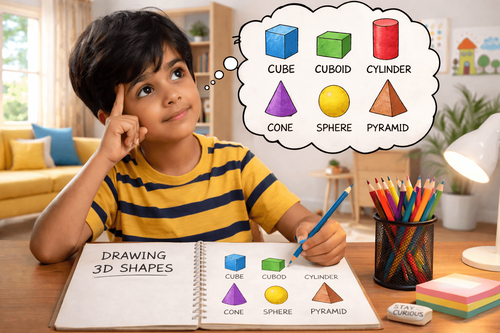

Table of Contents
Ever wondered how your child can turn simple shapes into amazing drawings? Shapes drawing is the first step into the world of creativity, where circles, squares, and triangles become building blocks for endless imagination. Before kids draw complex pictures, they master these basics to create anything they dream of. With platforms like PlanetSpark, learning becomes fun, interactive, and skill-focused. Kids don’t just draw, they learn to think creatively through expert guidance and engaging activities. In this guide, explore simple shapes to draw, drawing using lines and shapes, and easy 3D shapes, while discovering how PlanetSpark makes learning exciting and effective.
What is Shapes Drawing?
Shapes drawing is the technique of creating images using basic geometric forms. Instead of directly drawing complex objects, kids break them down into simple shapes and then combine them.
Why this method works so well:
- It simplifies complicated drawings into easy steps
- It improves understanding of structure and proportion
- It builds confidence in young learners
- It helps children draw independently without copying
PlanetSpark introduces shapes drawing through guided storytelling and interactive exercises. Instead of just asking kids to draw, it teaches them how to think in shapes, which is a foundational artistic skill.
Why Shapes Drawing is Important for Kids
Shapes drawing is not just an art activity—it supports overall development. Let’s break down its benefits in detail:
1. Improves Fine Motor Skills
When kids draw shapes, they control pencils, crayons, and brushes. This strengthens hand muscles and improves grip. With PlanetSpark, children practice structured drawing exercises that gradually improve hand coordination and precision.
2. Builds Creativity and Imagination
Shapes allow kids to transform simple forms into creative drawings like animals, vehicles, or fantasy characters. With PlanetSpark, kids are encouraged to create stories from their drawings, turning a simple circle into a sun, a face, or even a magical planet.
3. Strengthens Problem-Solving Skills
When children learn to draw a picture using different shapes, they think critically:
- Which shape fits where?
- How do shapes connect?
Guided sessions with planetspark help children break down complex drawings into manageable steps, improving logical thinking.
4. Enhances Academic Learning
Shapes are a key part of early math learning. Drawing them improves:
- Geometry understanding
- Spatial awareness
- Pattern recognition
Lessons of Planetspark integrates art with academics, making learning both fun and effective.
5. Boosts Confidence and Expression
Completing a drawing gives kids a sense of achievement. Children receive personalized feedback and encouragement while learning with Planetspark, helping them gain confidence in their abilities.
Step-by-Step Learning To Draw
1. Simple Shapes to Draw
Before moving to advanced drawings, kids must master simple shapes to draw. Let’s explore them in detail:
1. Circle
The circle is the most versatile shape.
Used to draw:
- Faces
- Balls
- Sun
- Fruits
Detailed Tip:
Encourage kids to draw circles slowly in a continuous motion instead of sketching repeatedly. Kids practice circles through fun activities like drawing emojis or planets.
2. Square
A square has four equal sides and is easy to construct.
Used to draw:
- Boxes
- Houses
- Tiles
Detailed Tip:
Teach kids to start with straight lines and connect them carefully.
3. Rectangle
A rectangle is an extended square.
Used to draw:
- Doors
- Books
- Tables
Detailed Tip:
Explain the difference between square and rectangle using real-life examples.
Spark your child’s creativity today, start their shapes drawing journey with PlanetSpark!
Book your free demo today
4. Triangle
Triangles are simple yet powerful.
Used to draw:
- Roofs
- Trees
- Mountains
Detailed Tip:
Teach kids to draw triangles in different sizes and directions.
5. Oval
An oval is a stretched circle.
Used to draw:
- Eggs
- Faces
- Balloons
Kids use ovals to create characters and objects in storytelling exercises.
2. Drawing Using Lines and Shapes
Drawing using lines and shapes is where kids start creating structured drawings.
Types of Lines (Explained in Detail):
- Straight Lines: Used for buildings, roads, and objects
- Curved Lines: Used for faces, animals, and soft shapes
- Zigzag Lines: Used for mountains or creative patterns
- Wavy Lines: Used for water, clouds, or decorations
Step-by-Step Activity:
- Draw different types of lines
- Add shapes to those lines
- Turn them into objects
Example:
- A circle + curved lines = fish
- Rectangles + straight lines = robot
Kids participate in guided drawing sessions where instructors help them combine lines and shapes creatively, making learning more interactive.
3. Basic 3D Shapes
3D shapes add depth, dimension, and realism to drawings. Unlike flat 2D shapes, 3D shapes look more lifelike because they show length, width, and height. Learning to draw these shapes helps kids understand how real-world objects are formed and improves their overall drawing skills.
Let’s explore each 3D shape in detail with easy steps and helpful tips:
1. Cube
A cube looks like a box and is one of the easiest 3D shapes to draw.
- Start by drawing a neat square
- Draw another square slightly behind and offset from the first one
- Connect the corresponding corners of both squares using straight lines
- Erase any extra lines to make the shape clean
Learning Tip:
Explain to kids that a cube has:
- Length (side to side)
- Width (front to back)
- Height (top to bottom)
This helps them understand how 3D objects exist in real space. Ask kids to draw everyday objects like a gift box or dice using cubes.
2. Sphere
A sphere looks like a ball and is perfectly round from all sides.
- Draw a clean circle
- Imagine a light source (like the sun) hitting one side
- Lightly shade the opposite side
- Blend the shading smoothly to create a gradual transition
Important Tip:
Do not use harsh lines while shading—keep it soft and smooth. Kids learn how to add light and shadow effects through guided practice, helping them turn a simple circle into a realistic 3D sphere.
3. Cylinder
A cylinder looks like a can or a glass.
- Draw an oval shape at the top
- From both sides of the oval, draw two straight vertical lines downward
- Draw another oval at the bottom to close the shape
- Add light shading on one side to show depth
Learning Tip:
Explain that cylinders have:
- A circular top and bottom
- Straight sides connecting them
Real-Life Examples:
Water bottles, candles, and pipes.
4. Cone
A cone looks like an ice cream cone or a party hat.
- Draw a triangle
- Replace the bottom line with a curved line (to show a circular base)
- Add light shading on one side for a 3D effect
Teach kids to imagine the cone standing upright, with a pointed top and a round base.
Fun Activity:
Ask kids to draw an ice cream cone and colour it creatively.
5. Pyramid
A pyramid has a flat base and triangular sides that meet at a point.
- Draw a triangle as the front face
- Add lines extending from the triangle to form the base
- Connect the lines to create the full 3D structure
- Shade one side slightly darker to show depth
Learning Tip:
Explain that pyramids are often seen in monuments and structures, making them interesting to draw.
Why Step-by-Step Learning Works
Breaking each shape into small steps makes it easier for kids to:
- Understand structure
- Avoid confusion
- Build confidence gradually
Instead of feeling overwhelmed, children learn one step at a time and improve with practice. With PlanetSpark, kids learn 3D shapes through interactive, step-by-step demonstrations. Instead of just copying drawings, they understand:
- How shapes are formed
- How to add depth and perspective
- How to use shading for realism
Guided sessions ensure that even beginners can easily grasp 3D drawing concepts while having fun. By practicing these 3D shapes regularly, kids can move from simple drawings to more advanced artwork, building a strong foundation in creativity and visual understanding.
4. Shapes Pictures Drawing (Creative Exploration)
Shapes pictures drawing allows kids to create complete scenes.
1. Animal Drawing
- Body → Oval
- Eyes → Circles
- Ears → Triangles
2. Nature Scene
- Sun → Circle
- Trees → Triangle + Rectangle
- Clouds → Ovals
3. Vehicle Drawing
- Wheels → Circles
- Body → Rectangles
4. Cartoon Creation
Break characters into shapes for easy drawing.
Kids are encouraged to narrate stories based on their drawings, boosting creativity and communication.
5. Draw a Picture Using Different Shapes (Step-by-Step Project)
Example: House Scene
- Draw a square for the house
- Add a triangle roof
- Draw rectangles for doors and windows
- Add a circle for the sun
- Include trees using triangles and rectangles
Skills Developed:
- Planning
- Creativity
- Shape recognition
PlanetSpark Edge:
Kids present their drawings and explain their ideas, improving confidence and speaking skills.
6. Fun Shapes Drawing Activities (Expanded)
1. Shape Challenge
Kids create unique drawings from one shape.
2. Guess the Drawing
One child draws, others guess.
3. Story Drawing
Kids draw a story using shapes.
4. 3D Practice Sessions
Regular practice of cubes, spheres, and cones.
Interactive sessions of Planetspark make these activities more engaging and structured.
Turn simple shapes into big ideas, enroll your child in PlanetSpark now!
Book your free demo today
Colouring 3D Shapes (Detailed Guide)
Colouring is what truly brings 3D shapes to life. While drawing gives structure, colouring adds depth, realism, and personality to the artwork. When kids learn the right colouring techniques, even simple shapes like cubes, spheres, and cones can look realistic and visually appealing.
Let’s explore the most important techniques in detail:
1. Understanding Light and Shadow
One of the key elements of colouring 3D shapes is knowing how light works.
- Every object has a light source (like the sun or a lamp)
- The side facing the light appears brighter
- The opposite side appears darker, creating a shadow
How kids can practice:
- Start with a simple sphere
- Colour one side lightly
- Gradually make the opposite side darker
This creates a smooth transition and gives the shape a 3D effect instead of a flat look.
2. Colour Blending for Realistic Effects
Blending helps colours look smooth instead of patchy.
Why it matters:
- Makes drawings look soft and natural
- Removes harsh lines between shades
- Adds a professional touch
How to blend:
- Use two shades of the same colour (light and dark)
- Start with the lighter shade
- Slowly add darker colour and blend in circular or back-and-forth motions
Kids can also use tools like colour pencils, crayons, or sketch pens to experiment with blending.
3. Direction of Colouring
The way kids move their hands while colouring makes a big difference.
Best practices:
- Colour in one consistent direction
- Avoid random scribbling
- Use smooth, even strokes
Benefits:
- Gives a neat and clean finish
- Improves control and precision
- Makes the drawing look more polished
For example, when colouring a cube, kids can colour each face in a single direction to maintain uniformity.
4. Layering Colours
Layering means applying colours gradually instead of pressing hard at once.
Steps:
- Start with a light base layer
- Add another layer to deepen the colour
- Repeat until the desired shade is achieved
Why it helps:
- Prevents rough texture
- Allows better control over shading
- Creates depth and richness
5. Choosing the Right Colours
Encourage kids to think about colours creatively.
Ideas:
- Use realistic colours (like blue for the sky)
- Or go imaginative (like a purple sun!)
This helps children:
- Express their personality
- Build confidence in their choices
6. Creativity Over Perfection
The most important rule is to have fun.
- There is no “wrong” colour
- Mistakes are part of learning
- Every drawing is unique
Encourage kids to:
- Try new colour combinations
- Experiment with shading styles
- Enjoy the process instead of worrying about perfection
By mastering these colouring techniques, kids can transform simple 3D shapes into vibrant, realistic artwork—making their drawings truly stand out.
Help your child draw, imagine, and shine with PlanetSpark’s expert-led classes!
Book your free demo today
Drawing with Shapes for Kindergarten (Detailed Approach)
Drawing with shapes for kindergarten should be simple, engaging, and playful.
Key Learning Principles:
- Keep instructions short and clear
- Use bright colours
- Encourage imagination over perfection
Activities in Detail:
1. Shape Transformation Activity
Kids are given a shape and asked to turn it into something fun.
Example:
- Circle → Sun or face
- Triangle → Ice cream cone
Kids also describe their drawings, improving both art and communication skills.
2. Connect and Create
Children connect multiple shapes to create a full picture.
Skill Developed:
- Logical thinking
- Visual planning
3. Colour Recognition Activity
Kids colour shapes using specific colours.
Skill Developed:
- Colour identification
- Attention to detail
4. Real-Life Shape Hunt
Kids identify shapes in everyday objects.
Example:
- Clock → Circle
- Door → Rectangle
Teachers guide kids to relate drawings to real-world objects, improving observation skills.
Common Mistakes and How to Improve
1. Uneven Shapes
Solution: Practice slowly and carefully
2. Lack of Practice
Solution: Daily drawing habit
3. Fear of Mistakes
Solution: Encourage experimentation
4. Overcomplication
Solution: Start with simple shapes
How PlanetSpark Makes Shapes Drawing Better
PlanetSpark enhances shapes drawing by blending creativity with structured learning, ensuring that kids not only learn how to draw but also develop essential life skills. Its approach goes beyond traditional methods, making learning more engaging, personalized, and effective for every child.
Key Benefits in Detail:
- Personalized Learning
Every child learns at their own pace, and PlanetSpark understands this well. Lessons are tailored based on the child’s skill level, helping beginners build strong foundations while allowing advanced learners to refine their techniques. This individual attention ensures steady improvement without pressure. - Interactive Classes
Live, engaging sessions keep kids interested and motivated. Instead of passive learning, children actively participate, ask questions, and practice drawing in real time. This makes shapes drawing enjoyable rather than routine. - Creative Expression
Kids are encouraged to think beyond instructions and use their imagination. They are guided to turn simple shapes into unique drawings, helping them express their ideas freely and confidently. - Skill Development
PlanetSpark focuses on overall growth by improving both drawing and communication skills. Children learn to describe their artwork, present ideas, and build storytelling abilities alongside artistic skills. - Confidence Building
Regular feedback and encouragement help children overcome hesitation. As they improve, their confidence grows, motivating them to explore and create even more.

Small Shapes, Big Creative Future
Shape drawing builds the foundation of every child’s artistic journey. By practicing simple shapes to draw, exploring drawing using lines and shapes, and creating shapes pictures drawing, kids unlock endless creativity. When children learn to draw a picture using different shapes, they naturally develop confidence, imagination, and problem-solving skills. With expert guidance from PlanetSpark, this learning becomes more engaging, structured, and impactful. It’s not just about drawing, it’s about thinking creatively and expressing ideas. Encourage your child to explore, draw, and dream every day, because every great artist begins with the simplest shapes.
Learn More:-
Frequently Asked Questions
Shapes drawing is a method where kids use basic shapes like circles, squares, and triangles to create pictures. It helps them learn drawing in a simple and structured way.
Learning shapes helps children understand how objects are formed. It improves creativity, observation skills, and makes drawing complex pictures easier.
Beginners can start with circles, squares, rectangles, triangles, and ovals. These basic shapes act as the foundation for all drawings.
Kids can draw 3D shapes by adding depth to basic shapes. For example, drawing two squares and connecting them creates a cube, while shading adds a realistic effect.
PlanetSpark offers guided sessions where kids learn shapes drawing step by step. It focuses on creativity, structured learning, and interactive activities to make drawing fun and effective.
Yes, PlanetSpark classes are designed for all skill levels. Beginners receive personalized guidance to build strong basics, while advanced learners improve their techniques.
Kids develop creativity, communication skills, confidence, and problem-solving abilities. They also learn to express their ideas clearly through drawings and storytelling.