
Types of Imagery Explained: Build Creative Skills at PlanetSpark

Table of Contents
- What Are Types of Imagery & Their Definition
- Different Types of Imagery Explained
- Imagery Literary Examples from Famous Works
- From Ideas to Achievements: A Young Star’s Creative Journey
- How Writers Combine Different Types of Imagery
- Types of Imagery in Academic and Creative Writing
- Why PlanetSpark Is the Best Place to Build Exceptional Skill
- Turn Imagination into Impactful Expression with PlanetSpark
Struggling to make your writing come alive and hold a reader’s attention?
Types of imagery help writers create vivid pictures in readers’ minds by using descriptive language that appeals to the senses. This guide explains various imagery types, accompanied by simple meanings and examples, to enhance creative expression. With structured lessons, engaging practice, and expert feedback, PlanetSpark helps students master imagery, improve storytelling, and build confident writing skills that make their ideas more expressive, impactful, and memorable across academic and creative writing tasks.
What Are Types of Imagery & Their Definition
Imagery is a writing technique that uses descriptive language to appeal to the five senses, which include sight, sound, touch, taste, and smell. It helps readers form clear mental pictures and experience a scene as if they are part of it. Instead of directly explaining what is happening, imagery allows writers to show details through sensory descriptions, making writing more vivid and engaging.
Each type of imagery plays a specific role in shaping a reader’s understanding of a text. Visual imagery helps readers see scenes clearly, auditory imagery recreates sounds, tactile imagery describes physical sensations, gustatory imagery focuses on taste, and olfactory imagery brings out smells. When writers understand which type of imagery they are using, they can control mood, tone, and emotional impact more effectively.
Imagery is widely used in poems, stories, essays, and speeches because it strengthens expression, deepens meaning, and keeps readers emotionally connected to the writing.
Why Types of Imagery Make Writing Come Alive
Imagery is a powerful writing tool that transforms simple descriptions into engaging experiences for readers. By appealing to the five senses—sight, sound, touch, taste, and smell—imagery helps readers step inside a scene rather than just read about it. When writers use the right type of imagery, their words become more expressive, emotional, and memorable.
Key points about types of imagery:
Appeals directly to the five senses, creating vivid mental pictures
Helps readers visualise scenes and connect emotionally with the text
Influences the tone, mood, and overall atmosphere of writing
Makes descriptions lively, detailed, and interesting
Encourages active reader involvement and imagination
By understanding how different types of imagery work, writers can choose sensory details more effectively. This not only strengthens storytelling and poetry but also improves descriptive essays and speeches, making writing clearer, richer, and more impactful for readers.
Different Types of Imagery Explained
There are different types of imagery, each linked to a specific sense. Writers often combine multiple types to create rich, layered descriptions. Let us learn each type of imagery in detail.
1. Visual Imagery: Painting Pictures with Words
Visual imagery appeals to the sense of sight. It helps readers see colors, shapes, movements, and spatial details.
Visual Imagery in Poetry
Visual imagery in poetry is especially powerful because poems rely on condensed language. Poets use strong visual details to convey emotion and meaning in fewer words.
Example:
The golden sun dipped behind crimson hills,
Casting long shadows across silent fields.
This imagery allows readers to see the scene clearly.
Visual imagery improves:
Scene description
Character appearance
Setting creation
Mood building
PlanetSpark students practise visual imagery through poem writing, storytelling, and picture-based prompts.
Help Your Child Become a Powerful Young Storyteller!
2. Auditory Imagery: Sounds That Echo in the Mind
Auditory imagery describes sounds as soft, loud, pleasant, or harsh.
Auditory Imagery Example:
The crackling fire whispered secrets as the wind howled outside.
Auditory imagery is commonly used in:
Storytelling
Dialogue writing
Poetry and song lyrics
Though subtle, it adds realism and emotional depth when paired with other imagery words.
3. Tactile Imagery: Describing the Sense of Touch
Tactile imagery refers to descriptions of physical sensations—texture, temperature, pressure, and movement.
Writers use tactile imagery to make scenes feel real and immersive.
Tactile Imagery Examples
Here are clear tactile imagery examples:
The icy wind stung her cheeks.
The rough bark scraped his palms.
The warm sand slipped between her fingers.
Tactile imagery strengthens:
Emotional scenes
Action writing
Personal narratives
At PlanetSpark, students practise tactile imagery through sensory exercises and creative storytelling tasks.
4. Olfactory Imagery: The Power of Smell
Olfactory imagery describes smells. Smell is closely linked to memory, making this imagery emotionally powerful.
Olfactory Imagery Examples:
The scent of fresh rain filled the air.
Burnt toast and bitter coffee lingered in the room.
Olfactory imagery is often used to:
Set mood
Trigger memories
Build atmosphere
Students at PlanetSpark learn how olfactory imagery can instantly transport readers to a specific place or moment.
Build Strong Writing Skills That Last a Lifetime!
5. Gustatory Imagery: Describing Taste
Gustatory imagery appeals to the sense of taste. Though used less frequently, it adds richness when describing food, experiences, or emotions.
Gustatory Imagery Examples
Here are simple gustatory imagery examples:
The chocolate melted sweetly on her tongue.
The soup tasted bitter and salty.
Gustatory imagery helps young writers:
Write vivid food descriptions
Add realism to scenes
Improve narrative detail
5. Kinesthetic Imagery: Movement and Action
Kinesthetic imagery describes motion and physical movement.
Kinesthetic Imagery Example:
He sprinted down the track, muscles burning, breath racing.
This imagery is common in:
Sports writing
Action scenes
Adventure stories
PlanetSpark encourages students to use kinesthetic imagery to make stories energetic and engaging.
6. Imagery Words: The Building Blocks of Description
Strong imagery words bring writing to life. These are descriptive verbs, adjectives, and nouns that appeal to the senses.
Examples of imagery words:
Visual: shimmering, glowing, shadowy
Tactile: icy, rough, silky
Olfactory: fragrant, musty, smoky
Gustatory: sweet, sour, bitter
Auditory: echoing, buzzing, crackling
Expanding imagery words improves vocabulary, expression, and creativity—key learning goals at PlanetSpark.
Turn Everyday Experiences Into Extraordinary Stories!
Imagery Literary Examples from Famous Works
Imagery literary examples help readers understand how authors use sensory language to create vivid impressions and emotions. Each example appeals to one or more senses, making the writing memorable and expressive.
Examples from literature:
“The old house smelled of dust and forgotten dreams.”
→ Olfactory imagery that conveys neglect and nostalgia“The leaves crunched under his boots as he walked.”
→ Auditory and tactile imagery showing movement and sound“The sun spilt golden light across the quiet field.”
→ Visual imagery creates a peaceful atmosphere“Her voice was as soft as falling snow.”
→ Auditory imagery suggesting calm and gentleness“The soup burned his tongue with bitter heat.”
→ Gustatory and tactile imagery showing taste and sensation
These imagery literary examples show how sensory details help writers express mood, emotion, and setting more effectively than plain description.
From Ideas to Achievements: A Young Star’s Creative Journey
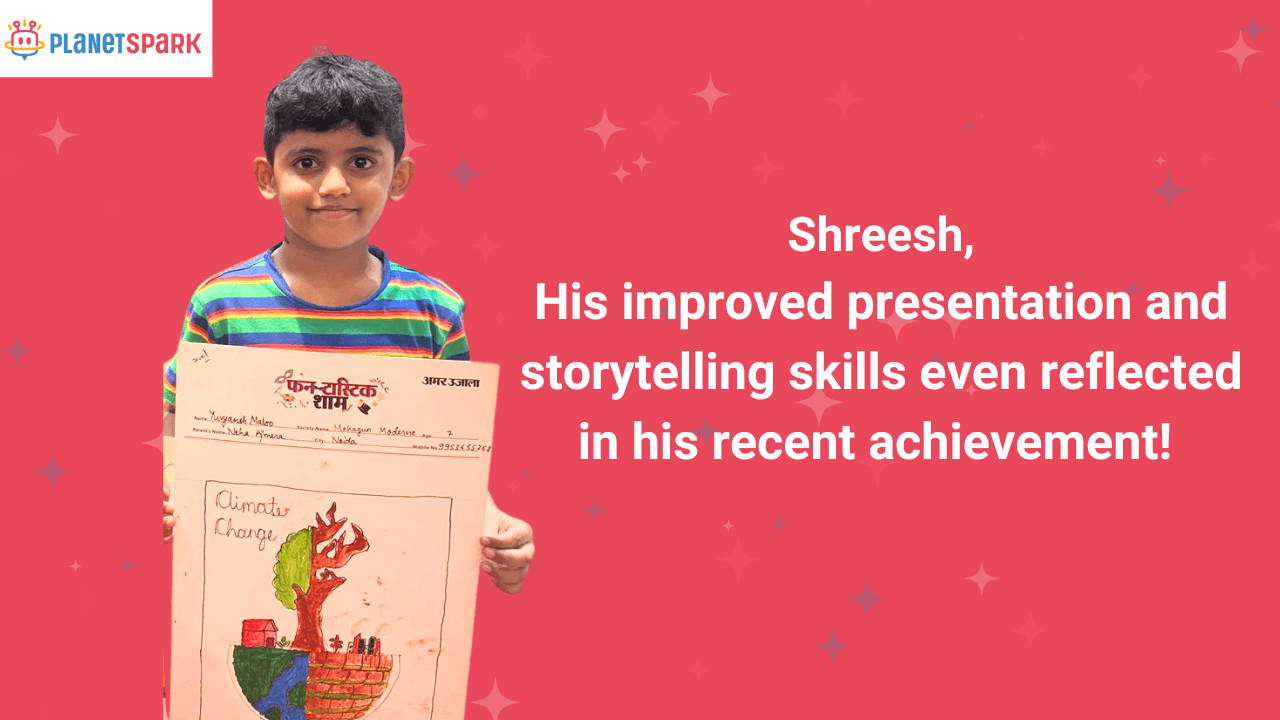
PlanetSpark has helped Shreesh express his ideas creatively and confidently. His improved presentation and storytelling skills are even reflected in his recent achievement — winning second place in the Junior Category of a drawing competition on ‘Climate Change’ organised by the Amar Ujala team.
If you want your child to think creatively, communicate confidently, and turn imagination into real achievements, join PlanetSpark and begin their journey toward expressive success today.
How Writers Combine Different Types of Imagery
Effective writing often blends different types of imagery to create rich, realistic descriptions. Instead of relying on a single sense, writers combine sensory details so readers can fully experience a scene. This technique makes descriptions more engaging and emotionally powerful.
Example:
The warm bread smelled heavenly, tasted buttery, and crumbled softly in his hands.
Types of imagery used:
Olfactory imagery – describes the inviting smell of the bread
Gustatory imagery – highlights the rich, buttery taste
Tactile imagery – shows the soft texture felt by touch
By combining imagery related to smell, taste, and touch, the sentence feels complete and lifelike. Readers can imagine the moment clearly, as if they are experiencing it themselves. Using multiple types of imagery together helps writers strengthen descriptions, build atmosphere, and create scenes that stay memorable long after reading.
Types of Imagery in Academic and Creative Writing
Understanding the types of imagery plays an important role in both academic and creative writing. When students use sensory details effectively, their writing becomes clearer, more engaging, and more expressive across different formats.
Imagery is commonly used in:
Poems to create strong emotions and vivid scenes
Short stories to build setting, characters, and mood
Essays to explain ideas more clearly and memorably
Speeches to hold attention and make messages impactful
Descriptive answers to add detail and depth in exams
Using appropriate imagery helps students present ideas in a structured yet creative way. It allows them to show understanding rather than simply state facts. As a result, writing feels more confident, well-developed, and interesting, which often leads to better engagement from readers and higher scores in school assessments.
Why PlanetSpark Is the Best Place to Build Exceptional Skills
PlanetSpark offers a complete learning ecosystem that helps children become confident, expressive, and imaginative writers. With expert-led classes, AI-powered tools, and engaging activities, students don’t just learn writing—they master the art of storytelling, clarity, structure, and creativity. Here’s how PlanetSpark transforms every child into a skilled young author:
What PlanetSpark Offers for Creative Writing Excellence
1:1 Personal Trainers who guide children through grammar, storytelling, vocabulary, and expression
Personalised Writing Curriculum tailored to your child’s level, goals, and pace
Spark Diary for daily writing practice that builds consistency and creativity
Genre-Based Learning covering stories, poems, essays, book reviews, speeches, and more
Creative Stimulus Activities like story dice, picture prompts, and imagination games
Real Publishing Opportunities through blogs, e-magazines, anthologies, and showcases
SparkX AI Video Analysis to refine delivery when presenting written work
Gamified Tools like SparkBee and quizzes that strengthen grammar, vocabulary, and spelling
PlanetSpark ensures your child not only writes better but thinks sharper, imagines deeper, and communicates with confidence that lasts a lifetime.
Turn Imagination into Impactful Expression with PlanetSpark
Mastering the types of imagery empowers students to transform simple ideas into vivid, meaningful writing. When children learn to use sensory language confidently, their words begin to paint pictures, evoke emotions, and capture attention across poems, stories, essays, and speeches. Strong imagery not only enhances creativity but also builds clarity, confidence, and communication skills that last a lifetime.
At PlanetSpark, students are guided step by step to explore imagery, expand vocabulary, and apply creative techniques through expert-led sessions and regular practice. This supportive learning environment helps young writers discover their unique voice and express ideas fearlessly. With the right guidance, imagination turns into powerful expression, and PlanetSpark helps every child shine through words.
Also Read:
Learn Zeugma Meaning Usage and Examples With PlanetSpark
Vignette Meaning Explained: Learn Storytelling With PlanetSpark
Frequently Asked Questions
The main types of imagery include visual, auditory, tactile, olfactory, gustatory, and kinesthetic imagery. Each appeals to a different sense and helps writers create vivid, engaging, and emotionally rich descriptions.
Imagery helps students express ideas clearly, improve creativity, and connect emotionally with readers. It strengthens storytelling, poetry, and descriptive answers, making writing more memorable and impactful in both academics and creative tasks.
Imagery allows writers to show experiences instead of telling them. By using sensory details, students can build stronger scenes, richer characters, and engaging narratives that hold the reader’s attention.
Yes, using appropriate imagery improves clarity, depth, and expression in descriptive and narrative answers. Well-written responses with sensory details often stand out, helping students demonstrate understanding and earn higher marks.
PlanetSpark offers structured creative writing lessons, sensory exercises, and expert feedback. Students practise using different types of imagery in stories, poems, and speeches, building confidence and strong communication skills.
Children can start learning imagery from an early age. PlanetSpark introduces imagery through age-appropriate activities, helping young learners develop imagination, vocabulary, and expressive writing skills gradually and effectively.