
Learn Sentence Formation with 50 Jumbled Words with Answers
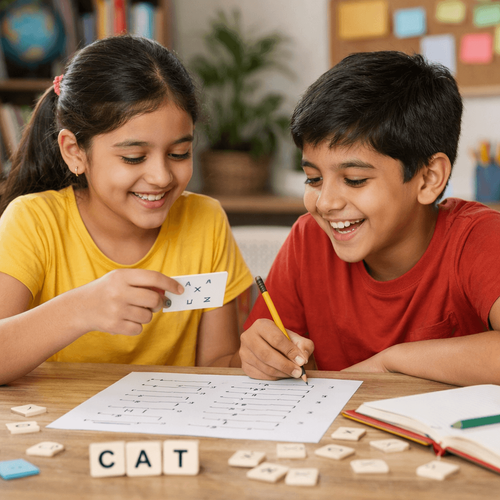

Do your kids enjoy puzzles and games?
Then jumbled words are the perfect way to learn English! Instead of forming sentences, kids rearrange letters to make correct words. This improves spelling, vocabulary, and thinking skills in a fun way.
In this blog, we will practice 50 jumbled words with answers, specially designed for kids.
What Are Jumbled Words?
Jumbled words are words where the letters are mixed up in the wrong order. Kids need to rearrange these letters to form the correct and meaningful word.
This simple activity works like a fun puzzle. Instead of just memorizing words, children actively think, analyze, and solve them. It makes learning English more interactive and enjoyable.
Jumbled words are especially helpful for kids because they improve spelling, vocabulary, and thinking skills at the same time. By practicing regularly, children can quickly become more confident in reading and writing.
Example:
Jumbled: tca
Answer: cat
Why Kids Should Practice:
Improves spelling
Builds vocabulary
Boosts thinking skills
Makes learning fun

Jumbled Words for Beginners, Intermediate & Pro:
Jumbled words can be divided into different levels based on difficulty. This helps kids learn step by step.
Beginner Level (3–4 letters)
Perfect for young kids who are just starting.
tac → cat
god → dog
nus → sun
yob → boy
Focus: Basic spelling and letter recognition
Intermediate Level (5–6 letters)
Slightly more challenging words.
elppa → apple
riahc → chair
loohcs → school
gdrane → garden
Focus: Vocabulary building and pattern recognition
Pro Level (7+ letters)
For advanced learners.
rehteaf → feather
sretis → sister
nrael → learn
hcaet → teach
Focus: Strong vocabulary and quick thinking
Jumbled Words (1–25) with Answers
tac → cat
god → dog
tacrh → chart
elppa → apple
nabana → banana
obok → book
eltab → table
riahc → chair
esoh → shoe
retaw → water
loohcs → school
rehteaf → feather
nus → sun
omno → moon
rtas → star
esroh → horse
tfihrg → fright
gdrane → garden
wloerf → flower
eerht → three
evif → five
xis → six
neves → seven
thgie → eight
enin → nine
Jumbled Words (25–50) with Answers
yob → boy
lrig → girl
rehtaf → father
rehtom → mother
sretihb → brothers
sretis → sister
hppay → happy
das → sad
tfaes → feast
niar → rain
niws → swim
pmuj → jump
nur → run
klaw → walk
etirw → write
daer → read
kaeps → speak
nrael → learn
hcaet → teach
emag → game
yalp → play
gnis → sing
ecnad → dance
kcah → hack
net → ten
Help your child improve English speaking and grammar skills with expert guidance—book a free trial class today!
Tips to Solve Jumbled Words Easily
Solving jumbled words becomes super easy when kids follow the right steps. Instead of guessing randomly, using simple tricks can help find the correct word quickly and confidently.
Start with the First and Last Letters
Look at the first and last letters of the jumbled word. Many times, they stay the same even when letters are mixed. This gives a strong clue about the correct word.
Example: tca → starts with t and ends with a → cat
Identify the Vowels First
Vowels (a, e, i, o, u) are very important in every word. Try placing vowels in different positions to see what makes sense.
Words like apple and table become easier once vowels are placed correctly
Look for Common Letter Patterns
Some letter combinations appear often in English, such as:
ch (chair)
sh (shoe)
th (three)
ing (playing)
Recognizing these patterns helps you solve words faster.
Break the Word into Parts
If the word is long, divide it into smaller parts and solve step by step, and then try forming simple sentences using those words.
Example: loohcs → think of parts like school
Say the Word Out Loud
Reading the letters aloud can help your brain recognize the correct word more easily.
This is especially helpful for younger kids.
Think of Familiar Words
Try to connect the jumbled letters with words you already know. If the letters look familiar, chances are you have seen the word before.
Don’t Rush – Take Your Time
Many kids make mistakes because they rush. Take a few seconds to think before answering.
Remember: Accuracy is more important than speed!
Always Recheck Your Answer
After solving, quickly check:
Is the spelling correct?
Does the word make sense?
This simple habit can help avoid small mistakes.
5-Minute Daily Practice Plan for Kids
Start with easy words and slowly move to harder ones, and then practice sentence-level exercises to improve grammar and structure.
Day 1: Solve 5 easy words
Day 2: Practice animal and fruit words
Day 3: Try action words
Day 4: Mix easy + medium words
Day 5: Revision day
Give your child the confidence to speak and write better with fun learning methods—book a free trial class now!
Fun Practice Challenge – Can You Solve These?
Make this interactive
Example:
tacob → ______
rbead → ______
plaepp → ______
Answers :
taco
bread
apple
Tips for Parents to Help Kids Learn Faster
Turn learning into a game
Use flashcards
Appreciate small wins
Practice daily with your child
Benefits of Practicing Jumbled Words
Improves spelling skills
Strengthens vocabulary
Enhances reading ability
Develops problem-solving skills
Makes learning fun and engaging
Common Mistakes Kids Make While Solving Jumbled Words
Solving jumbled words is fun, but kids often make small mistakes that can slow down their learning. Understanding these mistakes helps them improve faster.
Ignoring Vowels (a, e, i, o, u)
Vowels are very important in every word. Many kids try to arrange only consonants and forget vowels, which leads to wrong answers.
Tip: Always place vowels first to form a correct word.
Guessing Without Thinking
Some kids quickly guess the answer without analyzing the letters properly. This can lead to incorrect words.
Tip: Take a few seconds to think before answering.
Not Checking the Final Word
Kids may solve the word but forget to check if the spelling is correct.
Tip: Always recheck your answer before finalizing.
Mixing Similar Words
Words like form and from or trial and trail can confuse kids easily.
Tip: Read the word carefully and make sure it makes sense.
Rushing Too Fast
Trying to solve quickly can lead to simple mistakes, even if the child knows the answer.
Tip: Focus on accuracy first, speed will improve with practice.
Not Practicing Regularly
Skipping practice can slow down improvement and make learning harder.
Tip: Practice daily for 5–10 minutes for better results.
How Jumbled Words Help in Child Development
Jumbled words are more than just a classroom activity—they play a big role in a child’s overall development.
Improves Brain Power
When kids solve jumbled words, they train their brain to recognize patterns and think logically.
Builds Strong Vocabulary
Children learn new words while practicing spelling in a fun way.
Enhances Communication Skills
Better vocabulary leads to better speaking and writing skills, especially when children start practicing sentence formation.
Increases Focus and Attention
Kids concentrate more while solving puzzles, improving their attention span.
Boosts Confidence
Solving words correctly gives kids a sense of achievement and motivation.
In short, jumbled words turn learning into a fun brain exercise!
How PlanetSpark Helps Kids Master Jumbled Words and More
If your child enjoys solving jumbled words, imagine how much they can grow with the right guidance and structured learning.
PlanetSpark is designed to help kids go beyond basic learning and become confident communicators.
Why Choose PlanetSpark?
Focus on real-life communication skills
Builds confidence in speaking English
Encourages creative thinking
Personalized attention for every child
Key Features of PlanetSpark:
1:1 Live Interactive Classes
Expert Trainers for English & Communication
Fun Activities like word games, storytelling, and debates
Structured Curriculum for grammar and vocabulary
Public Speaking & Personality Development Training
Regular Feedback and Progress Tracking
PlanetSpark doesn’t just teach English—it helps children express themselves confidently.
Conclusion
Learning English doesn’t have to be difficult or boring.
With these 50 jumbled words with answers, kids can:
Learn new words
Improve spelling
Think faster
Enjoy the learning process
Make this a daily habit and watch your child grow into a confident English speaker!
Frequently Asked Questions
To rearrange jumbled words, first look for vowels and common letter patterns like ch, sh, or th. Then try placing the letters in an order that forms a meaningful word. Practice regularly to get faster and more accurate.
Here are 10 simple jumbled words: tac (cat), god (dog), elppa (apple), riahc (chair), loohcs (school), nus (sun), omno (moon), gdrane (garden), wloerf (flower), pmuj (jump). These help kids improve spelling and vocabulary.
Kids can learn jumbled words by practicing daily, starting with easy words and gradually moving to harder ones. Using games, flashcards, and puzzles makes learning more fun and effective.
Jumbled words for kids are words with mixed-up letters that children need to rearrange to form correct words. They are a fun way to improve spelling, vocabulary, and thinking skills.
Simple sentences are easy sentences with a subject and a verb. Examples include: I play, She runs, He eats, We study, and They sing. These sentences help kids understand basic English structure and improve communication skills.
PlanetSpark helps kids learn jumbled words through fun activities, games, and interactive exercises. With expert guidance, children improve spelling, vocabulary, and sentence formation in an engaging way
Parents should choose PlanetSpark because it offers personalized learning, expert teachers, and interactive sessions. It not only improves grammar and vocabulary but also builds confidence in speaking and communication skills.