
Exploring Mathematical Patterns and Their Logic | PlanetSpark
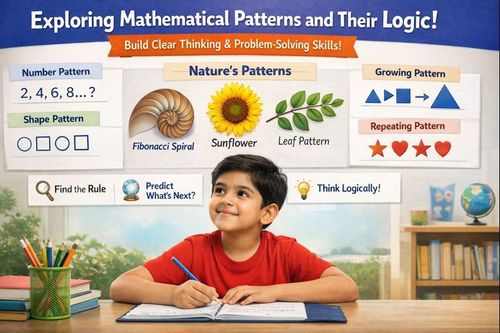

Table of Contents
- What are Mathematical Patterns in Maths
- Types of Mathematical Patterns
- How Patterns Help in Logical Thinking
- Number Patterns and Sequences
- Arithmetic Patterns Explained
- Geometric and Fibonacci Patterns
- Rules for Identifying Patterns
- Real Examples of Patterns in Maths
- Reason Why PlanetSpark’s Maths Classes Are the Best
- Final Thoughts
Mathematics is not just about numbers and formulas. It is about patterns that repeat, grow, and change predictably. From the tiles on your classroom floor to the petals of a flower, patterns are everywhere around us. Learning about mathematical patterns in maths helps students understand how numbers and shapes follow rules. Patterns make maths fun, visual, and logical for school children. When kids learn patterns early, they start recognising connections instead of memorising answers.
What are Mathematical Patterns in Maths
A mathematical pattern is a repeated arrangement of numbers, shapes, colours, or objects that follows a specific rule. Once you understand the rule, you can predict what comes next.
For example:
- 2, 4, 6, 8 follows a number pattern
- Circle, square, circle, square follows a shape pattern
These easy mathematical patterns help students spot order and structure in maths problems.
Key Features of Mathematical Patterns
- They repeat or grow in a logical way
- They follow a fixed rule
- They help predict future numbers or shapes
Understanding patterns builds a strong foundation for algebra, geometry, and problem solving.
Types of Mathematical Patterns
There are different types of mathematical patterns that students learn as they grow. Each type strengthens a different maths skill. The Common Types of Patterns are number patterns, shape patterns, growing patterns, and repeating patterns. Learning these patterns helps children understand how math works in real life and nature.
How Patterns Help in Logical Thinking
Patterns train the brain to think logically. When children identify a pattern, they learn to: observe carefully, compare elements, find relationships, and predict outcomes. This improves problem-solving skills and sharpens reasoning abilities. Logical thinking developed through patterns helps students perform better in maths. Patterns turn maths into a thinking game rather than a memorization task.
Help your child master patterns step by step with PlanetSpark’s expert-designed maths lessons.
Number Patterns and Sequences
Number patterns are one of the first and most important ideas students learn in mathematics. A number pattern is a sequence of numbers that follows a fixed rule. This rule tells us how the numbers change from one step to the next. When numbers are written in a particular order by following a rule, the group of numbers is called a sequence.
Examples of Number Patterns
- 5, 10, 15, 20
Each number increases by 5. The rule of this pattern is adding 5 every time.
- 100, 90, 80, 70
Each number decreases by 10. The rule of this pattern is subtracting 10 each time.
Once students understand the rule of a number pattern, they can easily predict the next number in the sequence.
Learning number patterns helps children clearly understand basic operations such as addition, subtraction, multiplication, and division. These patterns also prepare students for algebra, where finding rules and relationships between numbers becomes very important.
Build strong logical thinking skills early with PlanetSpark’s interactive maths program.
Arithmetic Patterns Explained
Arithmetic patterns are number patterns that follow basic mathematical operations. These operations include addition, subtraction, multiplication, and division. In arithmetic patterns, the same operation is applied repeatedly to move from one number to the next.
Examples of Arithmetic Patterns
- Additive pattern:
3, 6, 9, 12
A fixed number (3) is added each time.
- Subtractive pattern:
20, 15, 10, 5
A fixed number (5) is subtracted each time.
- Multiplicative pattern:
2, 4, 8, 16
Each number is multiplied by 2 to get the next number.
Understanding arithmetic patterns helps children calculate faster and recognize number relationships quickly. Instead of solving each step separately, students begin to see how numbers are connected. This makes mental maths easier and builds confidence in problem-solving.
Help your child spot arithmetic rules quickly with PlanetSpark’s smart maths techniques!
Geometric and Fibonacci Patterns
Geometric patterns are patterns made using shapes instead of numbers. These patterns repeat or grow by following a visual rule. They help students understand shapes, positions, and spatial thinking in a simple way.
Examples of Geometric Patterns
- Triangle, square, triangle, square
This shows a repeating shape pattern.
- Shapes that increase in size step by step
Each shape becomes bigger while keeping the same form.
- Shapes that rotate in a fixed direction
The shape turns slightly each time following a rule.
Fibonacci patterns are special number patterns that appear frequently in nature. In the Fibonacci sequence, each number is formed by adding the two numbers before it. The sequence starts as 1, 1, 2, 3, 5, 8, 13 and continues in the same way.
Examples of Fibonacci Patterns in Nature
- Arrangement of petals in flowers
- Spiral shapes of shells
- Pinecones and sunflowers
- Mathematical pattern in leaves
These mathematical patterns in nature help students understand that maths is not limited to books. It exists all around us in the natural world.
Explore fascinating patterns from maths and nature with PlanetSpark’s engaging lessons.
Rules for Identifying Patterns
Identifying patterns becomes easy when students follow a step-by-step approach. The first step is to carefully observe what changes or repeats in the sequence. Students should check whether the numbers are increasing, decreasing, or staying the same.
Next, they should look for the operation being used, such as addition, subtraction, or multiplication. Once the rule is identified, it should be tested by applying it to the next number. If the rule works, the pattern has been correctly identified.
Practicing these steps regularly helps children become confident in solving pattern-based questions. Over time, they begin recognizing patterns quickly without feeling confused or overwhelmed.
Real Examples of Patterns in Maths
Patterns are not limited to maths textbooks. They appear all around us in everyday life. Calendar dates follow a clear numerical pattern. Chessboards show repeating black and white squares. Musical rhythms repeat beats in a fixed order.
Even nature displays beautiful patterns. The mathematical pattern in leaves, symmetry in rangoli designs, and shapes in flowers all follow mathematical rules. Observing these real-life examples helps students understand why learning patterns is useful and meaningful.
When children connect maths with the world around them, learning becomes more interesting and enjoyable.
Connect real-world patterns to maths learning with PlanetSpark’s practical approach.
Reason Why PlanetSpark’s Maths Classes Are the Best
- Live interactive sessions led by experienced educators who introduce mental-calculation shortcuts (including Vedic maths tricks) and connect them directly to NCERT/CBSE exam problems.
- Customised practise modules focusing on arithmetic operations, algebraic expressions, quadratic equations and roots-so students apply the tricks within actual syllabus-aligned questions.
- Performance analytics & error-tracking tools that identify recurring calculation mistakes, helping students focus on improving speed and accuracy.
- Dedicated doubt-resolution and revision-boosters - which means that if any student is lagging on applying the tricks, the mentor provides targeted support and extra practice.
- Board-exam simulators with time-bound mock tests where students learn to use tricks under realistic exam conditions building confidence and speed.
Final Thoughts
Mathematical patterns form the foundation of learning maths. They help children think logically, recognize relationships, and solve problems with confidence. From easy mathematical patterns to advanced sequences found in nature, patterns make maths clear, structured, and exciting. With the right teaching approach and regular practice, every child can master patterns and enjoy learning maths.
Frequently Asked Questions
Mathematical patterns in maths are repeated arrangements of numbers, shapes, colours, or objects that follow a fixed rule. Once the rule is understood, students can easily predict what comes next. Learning patterns helps children understand maths concepts clearly and builds strong logical thinking skills.
Mathematical patterns help children develop logical thinking, problem-solving abilities, and number sense. They make it easier for students to understand addition, subtraction, multiplication, and division. Patterns also prepare children for advanced topics like algebra and geometry.
Some easy mathematical patterns for beginners include:
Number patterns like 2, 4, 6, 8
Shape patterns like circle, square, circle, square
Growing patterns where numbers or shapes increase step by step
These easy mathematical patterns help young learners understand order and rules in maths.
Mathematical patterns in nature are patterns that appear naturally around us. Examples include spiral shells, pinecones, sunflowers, and flower petals. Even a mathematical pattern in leaves follows number rules like the Fibonacci sequence. These patterns show that maths exists beyond textbooks.
Children can learn mathematical patterns easily through visual examples, real-life observations, and regular practice. Interactive learning, guided problem-solving, and step-by-step explanations make patterns easier to understand. Platforms like PlanetSpark help students learn patterns using simple methods, activities, and logic-based teaching.