
Top 10 Student Goals for Academic Mastery | PlanetSpark


Table of Contents
- Importance of Goals for Students
- Goal Setting for Students: Where to Start
- Top 10 Student Goals Examples for Academic Mastery
- Academic Goals for Students
- Short-Term Goals for Students vs Long-Term Goals for Student
- Personal Goals for Students
- SMART Goals for Students
- Student Productivity Goals and Study Strategies
- Goals for School Students vs Goals for College Students
- Goal Setting Strategies for Students
- Learning Goals for Students
- Build Confidence and Achieve Your Students' Goals with Plane
- Conclusion: Turn Your Goals into Reality
What if your hard work is not the problem, but the lack of direction is? Many students put in hours of effort but still feel stuck. The real issue is not effort but the absence of clear Students Goals. Without defined goals, studying becomes repetitive, overwhelming, and often ineffective.
This blog will help you understand how to set powerful goals for students, backed with real student goals examples, proven strategies, and practical steps. You will explore students' academic goals, short-term and long-term goals, SMART goals for students, and productivity techniques that actually work.
By the end, you will have a clear roadmap to turn your efforts into results and achieve true academic mastery.
Importance of Goals for Students
The importance of goals for students goes beyond just achieving marks. Goals give meaning to your efforts and clarity to your actions. Without goals, students often drift through studies without measurable progress.
Students' goals help in:
- Creating a clear direction
- Building discipline and consistency
- Improving focus and reducing distractions
- Tracking measurable progress
- Boosting confidence through achievements
Additionally, goals help students build a sense of responsibility. When students define their own goals, they take ownership of their learning journey rather than relying entirely on teachers or parents. This independence is a crucial life skill.
Goals also reduce stress and anxiety. When students know what they need to do and have a plan in place, they feel more in control. This clarity reduces last-minute panic and improves overall mental well-being.
For example, a student who sets a goal like “complete revision every Sunday” is far more likely to succeed than someone studying randomly.
In the long run, goal-oriented students develop habits like consistency, discipline, and resilience, which are essential not only for academic success but also for career growth.
Feeling stuck without direction? Book a free trial class today and discover how experts help students set winning goals. Limited slots available.
Goal Setting for Students: Where to Start
Goal setting for students begins with self-awareness and clarity. Before setting any goals, students need to pause and reflect on what they truly want to achieve and why it matters. Without this understanding, goals often become superficial and are easily abandoned. Strong students' goals are always rooted in purpose, whether it is improving academic performance, building confidence, or preparing for future careers.
To begin effectively, students should follow a structured approach:
1. Identify Your Priorities
Start by understanding what areas of your life need the most attention. Not all goals are equal, so prioritisation is key.
Focus on:
- Academic improvement, such as better grades or subject mastery
- Skill development, such as communication, critical thinking, or creativity
- Personal growth, including confidence, discipline, and emotional well-being
Ask yourself simple questions like:
- What subject do I struggle with the most?
- What skill do I want to improve this month?
- What habits are holding me back?
This clarity forms the foundation of meaningful goals for students.
2. Categorise Your Goals
Once priorities are clear, organise your goals into categories. This helps avoid overwhelm and creates a balanced development plan.
Common categories include:
- Study goals for students, such as completing the syllabus or improving test scores
- Career goals for students include exploring interests or preparing for future professions
- Personal goals for students, including confidence-building and better time management
Categorising ensures that you are not focusing only on academics but also on overall personality and skill development.
3. Make Goals Actionable and Specific
One of the biggest mistakes students make is setting vague goals. Goals like “I will study more” or “I will improve in math” lack clarity and direction.
Instead, convert them into actionable steps:
- Study science for 1 hour daily
- Solve 20 math problems every day
- Revise class notes every evening
Clear and specific goals increase accountability and make it easier to track progress. This is a key part of effective goal-setting strategies for students.

4. Break Goals into Smaller Steps
Large goals can feel overwhelming, which often leads to procrastination. Breaking them into smaller tasks makes them manageable and achievable.
For example:
Goal: Improve math score
Steps:
- Revise one chapter per week
- Practice problems daily
- Take a mock test every Sunday
This step-by-step approach builds consistency and confidence over time.
5. Track Your Progress Regularly
Tracking progress is essential to ensure that goals are being followed. Without tracking, it becomes difficult to measure improvement.
You can:
- Review your goals weekly
- Maintain a study journal
- Use planners or digital apps
Regular tracking helps identify what is working and what needs improvement. It also keeps you motivated by showing visible progress.
6. Stay Flexible and Adjust Goals
Sometimes goals may need to be adjusted due to changing priorities or challenges. Flexibility is important to stay consistent without feeling discouraged.
If a goal feels too difficult, break it further. If it feels too easy, increase the challenge. The key is to stay committed while adapting when needed.
In conclusion, goal setting for students is not just about writing goals but about creating a system to achieve them. When done correctly, it transforms daily efforts into meaningful progress and long-term success.
Want to turn goals into real results? Book your FREE demo class now and learn expert-backed strategies before seats fill up.
Top 10 Student Goals Examples for Academic Mastery
To achieve true academic mastery, students need to move beyond surface-level studying and focus on deep learning, consistency, and personal growth. The right Students Goals are not just about scoring marks but about building habits, skills, and a mindset that leads to long-term success.
Below are the most impactful student goals examples explained in detail, along with how you can actually apply them in your daily life.
1. Develop a Consistent Study Routine
Consistency is the foundation of success. A well-planned study routine helps students avoid last-minute cramming and reduces stress during exams.
Instead of studying randomly, create a fixed schedule:
- Study at the same time every day
- Divide subjects across the week
- Include revision slots
For example, you can dedicate 1 hour daily to math and 30 minutes to revision. Over time, this builds discipline and improves retention.
2. Master Effective Time Management
Time management is one of the most important goals for student productivity. Without it, even the best plans fail.
Use techniques like:
- Time blocking to assign specific hours to tasks
- Pomodoro technique to maintain focus
- Prioritisation using urgent vs important tasks
For instance, tackle difficult subjects when your energy is at its highest. This ensures better understanding and efficiency.
3. Implement Active Learning Techniques
Passive reading is not enough. Students must actively engage with the material to truly understand it.
Effective techniques include:
- Active recall by testing yourself
- Spaced repetition for long-term memory
- Teaching concepts to someone else
Example: Instead of rereading notes, try solving questions or explaining the topic aloud. This strengthens understanding and retention.
4. Raise Overall GPA (Targeted Improvement)
Improving grades should be a structured goal, not a vague wish.
Set measurable academic goals for students, such as:
- Increasing GPA from 7 to 8
- Improving marks in a specific subject
Break this into actions:
- Focus more on weak subjects
- Practice regularly
- Seek help from teachers
Tracking progress helps you stay motivated and focused.
5. Build a Strong Academic Network
Learning becomes easier when you are surrounded by the right people. Building a network is an important but often overlooked goal.
You can:
- Participate in study groups
- Ask teachers for guidance
- Collaborate with classmates
This not only improves understanding but also exposes you to different perspectives and problem-solving methods.

6. Create a Conducive Study Environment
Your environment directly affects your focus and productivity. A cluttered or distracting space reduces efficiency.
To improve your study environment:
- Keep your desk organised
- Remove distractions like phones
- Ensure proper lighting and comfort
A dedicated study space trains your brain to focus better and improves concentration over time.
7. Enhance Critical Thinking and Problem-Solving
Academic success is not just about memorisation. It is about understanding and applying concepts.
To build this skill:
- Ask “why” and “how” questions
- Solve real-world problems
- Practice analytical thinking
For example, instead of memorising formulas, understand how and why they work. This helps in exams and practical applications.
8. Prioritise Mental Health and Well-being
Many students ignore this, but mental health plays a crucial role in academic success. Without it, productivity drops significantly.
Focus on:
- Getting 7 to 8 hours of sleep
- Regular physical activity
- Taking breaks to avoid burnout
A healthy mind improves focus, memory, and overall performance.
9. Cultivate Resilience and Growth Mindset
Failures are part of learning. What matters is how you respond to them.
Students with a growth mindset:
- Learn from mistakes
- Stay motivated despite setbacks
- Keep improving strategies
For example, if you score low on a test, analyse your mistakes instead of feeling discouraged. This approach leads to continuous improvement.
10. Set SMART “Stepping Stone” Goals
Big goals can feel overwhelming. Breaking them into smaller SMART goals makes them achievable.
SMART goals are:
- Specific
- Measurable
- Achievable
- Relevant
- Time-bound
Example:
Instead of saying “I want to score better,” set a goal like:
“I will improve my science score by 15 per cent in 2 months by studying 1 hour daily.”
These stepping-stone goals create a clear path and keep you motivated.
Academic Goals for Students
Academic goals for students focus on improving learning outcomes, subject mastery, and overall academic performance. However, true academic success is not limited to marks alone. It also includes deepening understanding of concepts, applying knowledge, and developing critical thinking skills.
To make academic goals effective, they should always be measurable, realistic, and time-bound. Vague goals often lead to inconsistency, while clear goals create direction and motivation.
Common Academic Goals for Students
- Increasing GPA by a specific percentage
- Completing assignments before deadlines
- Mastering difficult subjects through consistent practice
- Participating actively in class discussions
For example, instead of saying “I want to improve in science,” a better goal would be “I will score above 80 per cent in science by revising daily and practising questions twice a week.”
Learning Goals for Students
Academic growth also depends on strong learning habits. Students should focus on:
- Asking questions to clarify doubts
- Practising regularly to reinforce concepts
- Revising consistently to improve retention
These habits build a strong academic foundation and ensure long-term excellence rather than short-term success.
Confused about setting the right goals for your future? Book your FREE trial class now and get a personalised goal roadmap before slots fill up.
Short-Term Goals for Students vs Long-Term Goals for Students
Understanding the difference between short-term and long-term goals is essential for effective planning and success. Both types of goals work together to create a balanced and achievable roadmap.
Short-Term Goals for Students
Short-term goals are achievable within a short period, such as days, weeks, or months. They act as quick wins that build motivation and momentum.
Examples include:
- Finishing homework daily
- Revising weekly
- Improving the next test score
These goals help students stay consistent and reduce procrastination by focusing on immediate actions.
Long-Term Goals for Students
Long-term goals focus on bigger achievements and future aspirations. These goals require sustained effort and planning.
Examples include:
- Achieving top grades in final exams
- Getting into a dream college
- Building a successful career path
Long-term goals provide direction and purpose, helping students stay committed over time.
Why Both Are Important
Short-term goals act as stepping stones toward long-term success. Without short-term goals, long-term goals can feel overwhelming and difficult to achieve.
For example:
- Short-term goal: Study 1 hour daily
- Long-term goal: Score above 90 per cent
When aligned properly, both create a clear and achievable success path.
Personal Goals for Students
Personal goals for students focus on emotional, social, and mental development. These goals are equally important as academic goals because they shape confidence, behaviour, and overall personality.
Examples of Personal Goals
- Building self-confidence
- Improving communication skills
- Managing stress effectively
- Developing discipline and positive habits
For instance, a student who improves communication skills will perform better in presentations, group discussions, and interviews.
Why Personal Goals Matter
Students who invest in personal development:
- Perform better academically
- Handle pressure more effectively
- Build stronger relationships
- Develop leadership qualities
Student improvement goals should always include both academic and personal growth to ensure holistic development.
Studying hard but still not seeing results? Try a FREE demo class and learn proven study techniques used by top-performing students. Limited seats available.
SMART Goals for Students
SMART goals for students provide a structured and proven framework for success. Without structure, goals often remain incomplete or unrealistic.
SMART stands for:
- Specific
- Measurable
- Achievable
- Relevant
- Time-bound
Example
Weak goal: Improve in math
SMART goal: Improve math score from 60 to 80 per cent by studying 1 hour daily for 3 months
This clarity makes goals actionable and easier to follow.
Why SMART Goals Work
- Provide clear direction
- Help track progress
- Prevent unrealistic expectations
- Increase accountability
SMART goals are among the most effective goal-setting strategies for students because they translate intentions into measurable actions.
Student Productivity Goals and Study Strategies
Student productivity goals focus on achieving better results with smarter effort. Studying for long hours does not guarantee success. Effective strategies matter more than time spent.
Key Productivity Strategies
- Use the Pomodoro technique to maintain focus
- Revise daily instead of cramming before exams
- Avoid multitasking to improve concentration
- Maintain an organised and distraction-free study space
Study Goals for Students
- Complete daily revision
- Practice regularly
- Track progress through tests
Consistency is the key. Even small daily efforts can lead to significant improvements over time.
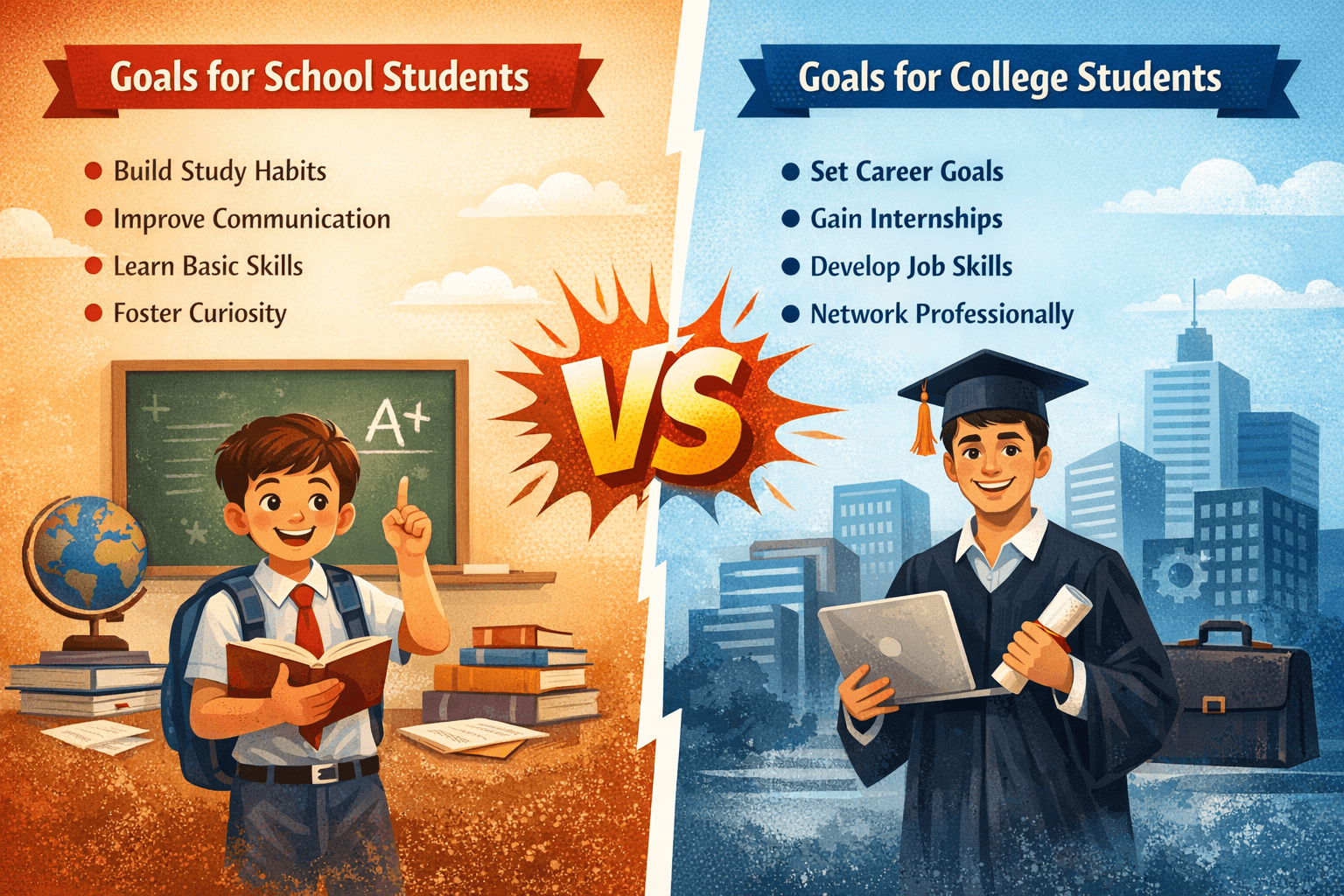
Goals for School Students vs Goals for College Students
Educational goals for students change as they grow. The expectations and responsibilities of school students and college students differ significantly.
Goals for School Students
Students in school should focus on building a strong foundation.
Key goals include:
- Developing basic academic skills
- Building discipline and study habits
- Improving communication and confidence
- Cultivating curiosity and interest in learning
At this stage, the focus should be on learning how to learn rather than just scoring marks.
Goals for College Students
College students need to prepare for real-world challenges.
Key goals include:
- Setting clear career goals
- Building practical and technical skills
- Gaining internships and experience
- Networking with professionals
At this stage, goals become more career-oriented and skill-focused.
Key Difference
- School goals focus on the foundation
- College goals focus on application and career
Understanding this difference helps students set realistic and relevant goals at every stage of life.
Want to boost confidence and communication skills? Book a FREE trial class now and give your child the edge they deserve before slots close.
Goal Setting Strategies for Students
Effective goal-setting strategies for students ensure consistency, clarity, and long-term success.
Proven Strategies
- Write your goals clearly
- Break goals into smaller tasks
- Set deadlines to create urgency
- Track progress regularly
- Reward yourself for achievements
One powerful technique is visualisation. Imagine achieving your goal and what it feels like. This increases motivation and commitment.
Why These Strategies Work
- They reduce overwhelm
- Improve focus
- Increase accountability
- Build consistency
Students who follow structured strategies are far more likely to achieve their goals than those who rely solely on motivation.
Learning Goals for Students
Learning goals for students focus on gaining knowledge and skills rather than just achieving grades. They encourage curiosity, exploration, and deeper understanding.
Examples of Learning Goals
- Understanding concepts deeply
- Asking questions in class
- Exploring topics beyond the syllabus
Why Learning Goals Matter
- Improve long-term retention
- Build critical thinking skills
- Enhance problem-solving abilities
Student development goals should always include continuous learning, as it prepares students for future challenges and opportunities.
Build Confidence and Achieve Your Students' Goals with PlanetSpark
PlanetSpark personality development classes are designed to help students develop confidence, communication skills, and leadership abilities. Many students struggle with expressing ideas, public speaking, and self-doubt, which directly affects their academic performance and future opportunities.
PlanetSpark addresses these challenges through structured, expert-led programs focused on real-world skill development.
Who is it for?
Students aged 4 to 18 and adults who want to improve communication, confidence, and personality.
What problems does it solve?
- Fear of public speaking
- Lack of confidence
- Poor communication skills
- Limited self-expression
Why structured learning matters
Unstructured learning often leads to slow progress and confusion. A guided curriculum ensures consistent improvement, expert feedback, and measurable growth.
Key Features and USPs
- Live 1:1 interactive classes with expert trainers
- AI-powered curriculum for communication mastery
- Real-world practice through debates and presentations
- Creative writing and storytelling development
- Personalised feedback and progress tracking
- Leadership and confidence-building activities
- Global exposure across 13+ countries
Skills Students Develop
- Public speaking
- Creative writing
- Body language and etiquette
- Leadership and critical thinking
- Emotional intelligence and confidence
PlanetSpark empowers students to become confident communicators, helping them succeed academically and professionally.

Conclusion: Turn Your Goals into Reality
Success is not accidental. It is built through clarity, consistency, and commitment. Students' goals act as the foundation of that success.
When you set the right goals, you stop working aimlessly and start moving with purpose. Every small step becomes meaningful, and every effort leads you closer to your dreams.
Stay consistent, keep improving, and believe in your ability to grow. With the right mindset and goals, academic mastery is not just possible but inevitable.
Frequently Asked Questions
PlanetSpark provides structured programs, expert mentorship, and personalised feedback to help students set and achieve meaningful goals.
Personal goals focus on confidence, communication, emotional intelligence, and overall personality development.
Academic goals include improving GPA, completing assignments on time, and mastering subjects through consistent practice.
Students can follow the SMART framework by setting goals that are specific, measurable, achievable, relevant, and time-bound. Our experts guide students step-by-step.
Examples include improving grades, developing communication skills, managing time effectively, and building confidence.
We believe goals provide clarity, direction, and motivation. They help students stay focused and achieve consistent progress.
At PlanetSpark, we define students' goals as structured objectives that guide academic, personal, and career growth with measurable outcomes.