
Positive Self-Talk for Kids: Turn the Inner Critic into a Coach
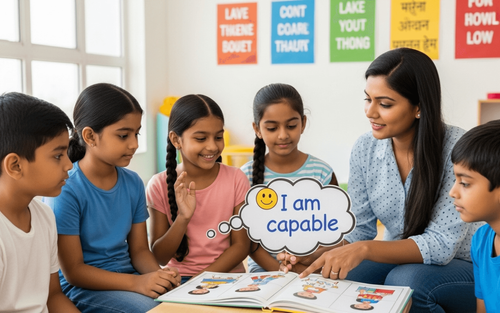

Table of Contents
- 9 Activities to Build Positive Self-Talk
- What Is Self-Talk?
- Why Positive Self-Talk Matters for Children
- Signs Your Child Has Negative Self-Talk
- Where Does Negative Self-Talk Come From?
- How to Teach Positive Self-Talk (Step-by-Step Framework)
- Positive Self-Talk Scripts for Kids (By Age)
- Common Mistakes Parents Make (And How to Avoid Them)
- When to Seek Professional Help
- How PlanetSpark Builds Positive Self-Talk Through Communicat
Your 8-year-old spills juice at breakfast. The glass tips. Orange liquid spreads across the table. You reach for a towel.
But before you can say anything,
your child freezes.
Her face crumples.
And she whispers:
"I am so stupid. I mess up everything."
Your heart breaks.
Where did they learn to talk to themselves like that?
You have never called them stupid.
You have never said they mess everything up.
Yet somehow, that cruel voice lives inside their head, and it's getting louder.
Here's the truth: Most parents don't realise that by age 7, most children have already developed an inner critic. A voice that judges, criticises, and undermines them. A voice they didn't ask for and don't know how to silence.
This inner voice, what psychologists call "self-talk," shapes everything: confidence, resilience, mental health, relationships, and future success.
Positive self-talk says, "I can try. Mistakes help me learn. I am getting better."
Negative self-talk says, "I am stupid. I can't do anything right. I will never be good enough."
Or even worse, “I am not important. I don’t matter.”
Same child. Different inner voice. Completely different life trajectory.
The devastating part? No one teaches kids HOW to talk to themselves. We teach them to read, write, and solve equations. But we don't teach them to be kind to the voice in their own head.
The empowering part? Self-talk is a skill. It can be taught, practiced, and transformed.
This guide gives you everything you need: exact scripts, daily activities, age-appropriate strategies, and real examples to help your child replace their inner critic with an inner coach.
Because the voice in your child's head will be the loudest voice they hear for the rest of their life.
And as parents and guardians, it's our responsibility to make sure it's a kind one.
9 Activities to Build Positive Self-Talk
Make self-talk practice playful, creative, and consistent.
What Is Self-Talk?
Self-talk is the voice in your head. The thoughts you think about yourself when no one else is listening.
It's the running commentary in your mind:
- I can do this.
- I am terrible at this.
- I'll try again.
- Why do I even bother?
Everyone has it, adults and kids. Imagine having a coach in your mind.
A good coach says:
- You can do this!
- Keep trying!
- Mistakes help you learn!
A mean coach says:
- You're terrible.
- Give up.
- You'll never be good enough.
Self-talk is choosing which coach gets the microphone.
Book a free session and help your child learn positive self-talk and meet their best personality.
Why Positive Self-Talk Matters for Children
Positive self-talk is essential for the healthy development of your child. Here's why:
Builds Resilience
Kids with positive self-talk bounce back faster from failure, rejection, and disappointment.
Improves Mental Health
Negative self-talk fuels anxiety and depression. Positive self-talk acts as a protective buffer against stress.
Research shows:
- Kids who practice positive self-talk report lower anxiety
- Negative self-talk is linked to higher rates of depression in children
- Self-compassion (being kind to yourself) predicts better emotional well-being
Boosts Academic Performance
Self-talk directly impacts effort, persistence, and willingness to take on challenges.
Strengthens Confidence
Inner voice shapes self-image. What you repeatedly tell yourself becomes what you believe about yourself.
Teaches Emotional Regulation
Positive self-talk helps kids calm themselves during stress, anger, or frustration.
Prepares for Life's Challenges
Adult life requires constant self-encouragement. Job rejections. Relationship struggles. Financial stress. Health issues.
The Story of Two Students
Meet Riya and Arjun. Both are 10 years old. Both fail a spelling test.
Riya's Self-Talk: I'm terrible at spelling. I'll never be good at it. Why do I even try? I'm just stupid.
What happens: Riya stops studying spelling. She avoids reading. She tells herself she "can't do it." By middle school, her reading and writing struggles were not because she lacked ability, but because she gave up.
Arjun's Self-Talk: I didn't study the right way. Next time, I'll practice more. I can improve if I keep trying.
What happens: Arjun asks his teacher for study tips. He practices daily. He fails a few more times, but he doesn't quit. By middle school, he's confident in his spelling and reading.
Same test. Same initial failure. But Riya internalised defeat. Arjun internalised growth.
The difference? Self-talk.
Signs Your Child Has Negative Self-Talk
How do you know if your child struggles with negative self-talk? Listen and watch.
Look for These Phrases
- I'm stupid
- I can't do anything right
- I'm the worst
- Everyone hates me
- I'll never be good at this
- Why do I even try?
- I always mess up
- I'm ugly/fat/dumb (teenagers/young adults)
Even one of these phrases, repeated regularly, is a red flag.
Watch for These Behaviours
- Giving up quickly: This is too hard → quits immediately
- Avoiding challenges: Refuses to try new things
- Excessive apologising: Sorry, sorry, sorry for tiny mistakes
- Perfectionism: Melts down over small errors and reacts impulsively
- Refusing to participate: Won't raise hand, won't volunteer
- Self-sabotage: I'll probably fail anyway
Emotional Signs
- Low confidence: I'm not good at anything
- High anxiety: Especially before tests, performances, and social situations
- Withdrawn or sad: Frequently down on themselves
- Harsh on themselves, lenient on others: Forgives friends' mistakes but not their own
Examples
Scenario 1: Your child drops a pencil. They say, "I'm so clumsy. I can't do anything right."
Scenario 2: They get a B+ on a test. They cry and say, "I'm not smart enough."
Scenario 3: They refuse to try out for the school play because "I'm not talented like the other kids."
Scenario 4: After one mistake in a game, they quit and say, "I'm terrible at sports. Everyone's better than me."
If you recognise 3 or more signs, your child likely struggles with negative self-talk.
But here's the reassuring part: you're already ahead by noticing. Awareness is the first step toward change.
Book a free session and help your child learn positive self-talk and meet their best personality.
Where Does Negative Self-Talk Come From?
Understanding the roots of negative self-talk helps you address it without blame or guilt.
Modelling (From Adults)
Kids absorb how adults talk about themselves.
Example:
Parent says: I'm so stupid. I can't believe I forgot that.
Child learns: It's normal to call yourself stupid when you make mistakes.
Parent says: Ugh, I'm so fat and ugly.
Child learns: Criticising your appearance is normal.
The Fix: Model positive self-talk out loud. Let them hear you being kind to yourself.
Criticism from Others
One harsh comment can echo for years.
Examples:
- A teacher snaps: Why can't you get this? It's easy.
- A peer laughs: You're so slow at reading.
- A family member jokes: You're the clumsy one in the family.
Even if meant harmlessly, kids internalise criticism and replay it in their heads.
Perfectionism
Kids with high standards often develop harsh self-talk.
The Pattern: Perfectionism → fear of mistakes → harsh self-judgment → negative self-talk
Example: A child gets 9 out of 10 questions right. Instead of celebrating, they fixate on the one mistake: "I'm so dumb. I should've gotten them all right."
Social Comparison
"She's smarter." "He's better at sports." "They're prettier."
Kids constantly compare themselves to peers and usually conclude they're "less than."
Social media amplifies this for older kids (ages 10+). Constant exposure to curated perfection makes them feel inadequate.
Past Failures
One bad experience can generalise into a permanent identity.
Example:
Past event: Child struggles with reading in 2nd grade.
Internalised belief: I'm bad at reading.
Result: Avoids reading for years, even after the ability improves.
They carry the outdated belief forward.
Lack of Coping Skills
Most kids simply don't know HOW to talk kindly to themselves. They've never been taught.
They know:
- How to tie shoes
- How to solve math problems
- How to follow rules
They don't know:
- How to comfort themselves after failure
- How to challenge negative thoughts
- How to reframe mistakes as learning
The good news? These are teachable skills.
This isn't about blame. Not yours. Not theirs. Negative self-talk develops for many reasons, and most are outside anyone's control.
What matters now is this: you can change it. And you're already taking the first step.
Book a free session and help your child learn positive self-talk and meet their best personality.
How to Teach Positive Self-Talk (Step-by-Step Framework)
Here's how to systematically build this life-changing skill.
Step 1: Model Positive Self-Talk Out Loud
Kids learn by imitation. If they never hear positive self-talk, they don't know it exists.
How to Do It:
Narrate your own self-talk so your child hears your thought process.
Examples:
Situation: You burn dinner.
Out loud: Oh no, I burned dinner. Oh well, mistakes happen. I'll order pizza tonight and try again tomorrow. No big deal.
Situation: You're stuck on a problem.
Out loud: Hmm, I'm stuck. Let me think... I can figure this out. Maybe I need to try a different approach.
Situation: You're nervous about a presentation.
Out loud: I'm feeling nervous about this presentation. But I've prepared well. I can do this. Even if I'm not perfect, I'll do my best.
Why It Works:
Your child hears that:
- Mistakes are normal
- You can talk yourself through challenges
- Being kind to yourself is okay
- Nervousness doesn't mean giving up
Make It a Habit:
Think aloud during daily tasks: cooking, driving, problem-solving, and planning.
Step 2: Name the Inner Voice
Help kids recognise that they HAVE an inner voice and that they can choose what it says.
Script to Use
Everyone has a voice inside their head. Sometimes it's kind. Sometimes it's mean. What does YOUR voice say when you make a mistake?
Listen without judgment. Let them share.
Activity: Name Your Voices
Give the voices character names.
The Kind Voice = "The Coach"
- Encouraging
- Supportive
- Realistic
The Mean Voice = "The Critic"
- Harsh
- Judgmental
- Discouraging
Ask: When you spilt juice this morning, was that the Coach talking or the Critic?
The Critic.
What would the Coach have said instead?
Accidents happen. Clean it up. You're okay.
Why It Works:
Externalising the voice creates distance. "The Critic is being mean" feels less personal than "I'm being mean to myself."
It also empowers kids: "I can choose which voice to listen to."
Step 3: Catch and Challenge Negative Thoughts
When you hear negative self-talk, gently interrupt and challenge it.
Child says: I'm terrible at math.
Parent response: Wait. Is that true? Or is math just hard right now?
Teach the 3-Question Challenge
When you notice a negative thought, ask:
- Is this thought TRUE?
Am I REALLY terrible? Or did I just struggle with this one problem? - Is this thought HELPFUL?
Does thinking 'I'm terrible' help me improve? Or does it make me want to give up? - What would I say to a friend who thought this?
If my friend said, 'I'm terrible at math,' would I agree? Or would I encourage them?
Example in Action:
Child: I'm so stupid.
Parent: Hold on. Let's check that thought. Is it TRUE that you're stupid?
Child: pause ...I don't know.
Parent: You got 8 out of 10 questions right. Is that stupid?
Child: No...
Parent: Is calling yourself stupid HELPFUL?
Child: No. It makes me feel bad.
Parent: What would you say to your friend if they said they were stupid?
Child: I'd tell them they're not stupid. They just made a mistake.
Parent: Exactly. So let's talk to YOU the same way.
Why It Works:
Questions activate critical thinking. Kids realize their harsh thoughts aren't facts, they're just thoughts. And thoughts can be changed.
Step 4: Replace with Realistic Positive Statements
Don't just remove negative thoughts, REPLACE them with kind, realistic alternatives.
Negative → Positive Rewrites:
Practice Together:
Make it a game. You say a negative thought. Your child rewrites it positively.
You: I'm bad at drawing.
Child: I'm learning to draw better.
You: I can't make friends.
Child: I haven't found my close friends yet, but I will.
Step 5: Practice Daily Affirmations
Affirmations are positive statements kids repeat to themselves regularly.
How to Do It:
Every morning, stand in front of the mirror together. Say 3 affirmations out loud.
Example Affirmations for Kids:
- I am capable
- Mistakes help me grow
- I am enough
- I can handle challenges
- My effort matters
- I am learning every day
- I am brave
- I deserve kindness from others and from myself
Make It a Routine:
Morning mirror talk: 3 affirmations while brushing teeth or getting dressed.
Why It Works:
Repetition rewires the brain. What you say often becomes what you believe.
Neuroscience Note: The brain forms neural pathways through repeated thoughts. Negative thoughts create negative pathways. Positive thoughts create positive pathways. Repetition strengthens the path you want.
Book a free session and help your child learn positive self-talk and meet their best personality.
Positive Self-Talk Scripts for Kids (By Age)
Different ages need different languages. Here are age-appropriate scripts.
Ages 6–8 (Early Elementary)
Simple, concrete, present-focused:
- I can try
- Mistakes are okay
- I am learning
- I am brave
- I can ask for help
- I am a good friend
- I am kind
Example in Action:
Child: I can't tie my shoes.
Reframe: I can't tie my shoes YET. I'm learning. I can ask for help.
Ages 9–11 (Upper Elementary)
More complex, includes growth concepts:
- I'm getting better with practice
- This is hard, but I can figure it out
- Everyone makes mistakes, including me
- I don't need to be perfect
- My best is good enough
- I'm allowed to struggle
- I'm learning something new
Example:
Child: I'm bad at math.
Reframe: Math is hard for me right now, but I'm getting better with practice.
Ages 12–14 (Middle School)
Abstract thinking, identity-focused:
- I'm allowed to struggle, but it doesn't define me
- This challenge doesn't determine my worth
- I've overcome hard things before; I can do it again
- My worth isn't based on others' opinions
- Progress matters more than perfection
- I'm learning who I am, and that's okay
- My mistakes don't make me a failure
Example:
Teen: Everyone thinks I'm weird.
Reframe: Some people don't get me, and that's okay. I'm figuring out who I am. The right people will appreciate me.
Common Mistakes Parents Make (And How to Avoid Them)
Even loving, well-meaning parents can accidentally reinforce negative self-talk. Here's what to avoid:
Mistake 1: Dismissing Their Feelings
What It Sounds Like: Don't be silly! You're not stupid!
Why It's Harmful: Dismisses their emotion. They feel unheard.
Better Approach: I hear you are feeling frustrated. But 'stupid' isn't true. You're learning something hard. That's different.
Why It Works: Validates emotion while gently correcting the thought.
Mistake 2: Toxic Positivity
What It Sounds Like: Just think happy thoughts! Be positive! Stop being negative!
Why It's Harmful: Invalidates real struggle. Teaches them to suppress feelings.
Better Approach: It's okay to feel upset. This IS hard. AND you can remind yourself that you'll get through it.
Why It Works: Balances validation with hope.
Mistake 3: Modelling Negative Self-Talk
What It Sounds Like: I'm so fat and ugly. I'm such an idiot. I can't do anything right.
Why It's Harmful: Kids copy what they hear. If you're cruel to yourself, they learn to be cruel to themselves.
Better Approach: I'm working on being healthier. I made a mistake. I'll fix it. That didn't go as planned. I'll try differently next time.
Why It Works: Models self-compassion.
Mistake 4: Overpraise (Insincere or Empty)
What It Sounds Like: You're perfect! You're the best at everything! You never make mistakes!
Why It's Harmful: Sets unrealistic standards. Kids know it's not true. When they inevitably fail, they feel like frauds.
Better Approach: You tried hard and didn't give up. That's what I admire. You made a mistake and fixed it. That takes courage.
Why It Works: Praises effort and character, not just outcomes.
Mistake 5: Not Addressing Negative Self-Talk
What It Looks Like: Child says, "I'm stupid." Parents say nothing or change the subject.
Why It's Harmful: Silence = acceptance. The child thinks it's true.
Better Approach: Wait. Let's pause. Is that true? Are you really stupid?
Gently challenge. Open dialogue.
Why It Works: Shows you're listening and that their words matter.
When to Seek Professional Help
Teaching positive self-talk is powerful. But sometimes, professional support is necessary.
Seek help if:
- Negative self-talk is constant and severe ("I hate myself" multiple times daily)
- Child shows signs of depression: Withdrawal, hopelessness, loss of interest in activities
- Self-harm or suicidal thoughts (any mention, take seriously)
- Self-talk doesn't improve despite consistent intervention (3+ months)
- Impacts daily functioning: Can't go to school, make friends, sleep, or eat normally
- Extreme anxiety tied to negative thoughts

How PlanetSpark Builds Positive Self-Talk Through Communication
At PlanetSpark, we don't just teach kids to speak loudly. We teach them to speak KINDLY to others and to themselves.
How We Build Positive Self-Talk
- Public Speaking Practice: When kids practice speaking in front of others, they develop their external voice. A strong external voice strengthens the internal voice.
- Confidence through expression: Kids who can say "I tried my best" out loud learn to think it internally.
- Encouragement Culture: We celebrate effort, mistakes, and growth, not just perfection.
- Growth Mindset Language: Our teachers model positive self-talk daily, so it becomes the inner voice of your child.
- Safe Environment: No judgment. No ridicule. Only support. Kids practice, fail, improve, and try again, all while being cheered on.
The Result?
- Kids who cheer themselves on instead of tearing themselves down.
- Kids who say "I can try" instead of "I can't."
- Kids whose inner coach is louder than their inner critic.
- Kids who believe in themselves, not because they're perfect, but because they've learned to be kind to the voice in their own head.
Book Your Free Trial and help your child build a kinder, stronger inner voice with PlanetSpark.
Twenty years from now, your child will face heartbreak.
They'll experience rejection. Failure. Disappointment. Loss.
They'll apply for jobs and not get them. They'll try relationships that don't work out. They'll face challenges that feel impossible.
And in those moments, you won't be there to whisper encouragement.
But what if you teach them to be kind to themselves NOW?
That kind inner voice will be there forever.
Comforting them when they're alone.
Encouraging them when they want to give up.
Believing in them even when no one else does.
The voice in your child's head will be the loudest voice they hear for the rest of their life.
It will shape their confidence, their resilience, their relationships, their career, and their mental health.
It will either lift them up or tear them down.
And right now, today, you have the power to shape that voice.
Model positive self-talk. Catch and challenge negative thoughts. Replace harsh words with kind ones. Practice affirmations. Celebrate effort. Be patient.
Your child is learning to be their own best friend. And you're teaching them how.
At PlanetSpark,
we believe every child deserves a voice that encourages, not one that destroys.
Every child deserves to think, "I am capable. I am worthy. I am enough."
And every child deserves parents and teachers who help them build that belief, one kind thought at a time.
Start today. The voice in their head is listening.
Make sure it's a voice worth listening to.
Here’s more for creative and curious souls who believe in running an extra mile. A fun and easy reading of:
How positive self-talk can transform your confidence
How to build self-confidence in kids
Self-Improvement: A guide for kids to build personality
Frequently Asked Questions
As early as age 4-5. Young children are already developing their inner voice. The earlier you teach kind self-talk, the stronger the foundation. But it's never too late. Teens and adults can learn too.
Some negative self-talk is normal, especially during challenging tasks. But frequent, harsh self-criticism ("I'm stupid," "I hate myself") is concerning and should be addressed with teaching, support, and possibly professional help.
Yes. Research shows that consistent positive self-talk rewires neural pathways in the brain, improves resilience, reduces anxiety, and boosts confidence. It takes time and practice, but the changes are real and lasting.
That's common, especially with older kids. Don't force it. Instead:
- Make it private (mirror talk alone, not in front of siblings)
- Use realistic statements ("I'm learning" vs. "I'm the best")
- Lead by example. Let them hear YOU doing it
- Make it feel less formal (journal instead of mirror talk)
It varies. Some kids show improvement in 2-4 weeks with consistent practice. Deep-rooted negative patterns may take 3-6 months. The key is consistency—daily practice, gentle reminders, and patience.
No. Constantly correcting can feel exhausting for both of you. Pick your moments:
- Address severe statements ("I'm worthless")
- Address patterns (same negative thought repeatedly)
- Let minor complaints pass ("This homework is boring")
Focus on teaching the skill, not policing every word.
PlanetSpark teaches kids to speak with confidence using games, stories, and fun speaking practice in one-on-one live classes that build early communication habits.
Leadership development can begin as early as preschool through simple activities like sharing, taking turns, and helping others. Every age presents appropriate opportunities for building leadership abilities.
Teach assertiveness, build confidence, discuss real-life scenarios, and practice refusal skills through role-play.