
Class 4 Worksheet on Direct and Indirect Quotations

Class 4 Worksheet on Direct and Indirect Quotations
Say It Two Ways: Direct and Indirect Quotations for Grade 4
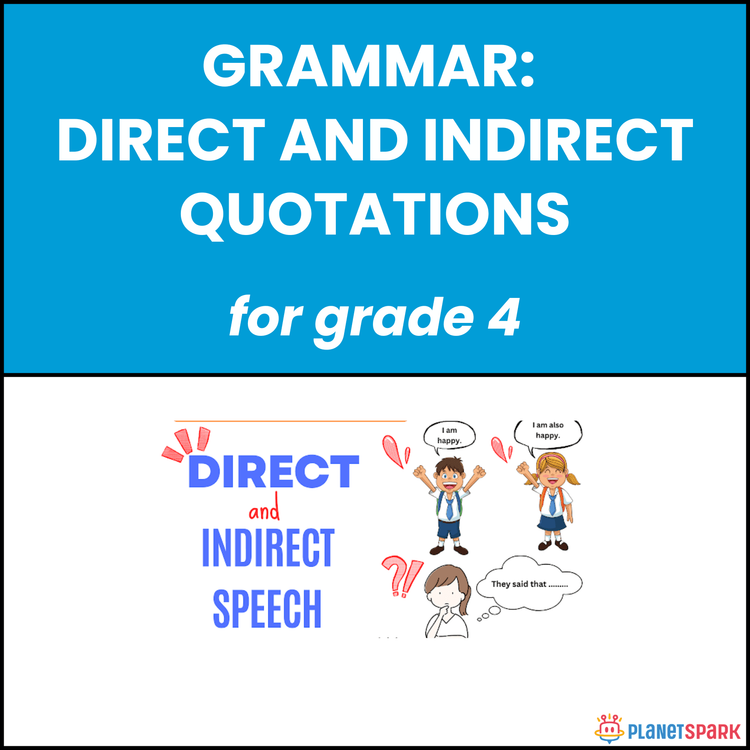
This Grade 4 grammar worksheet helps students understand the difference between direct and indirect quotations and how to use each form correctly in sentences and passages. Learners discover that direct quotations show the exact words spoken using quotation marks, while indirect quotations report speech without quotation marks and with correct tense and pronoun changes.
Through carefully scaffolded practice, students move from identifying correct quotation forms to rewriting sentences and editing a full paragraph. These activities strengthen grammar accuracy, reporting skills, and overall clarity in both spoken and written communication.
Why Learning Direct and Indirect Quotations Matters?
Understanding direct and indirect quotations helps children:
1. Clearly report what someone said in different ways.
2. Use quotation marks correctly only when needed.
3. Make correct tense and pronoun changes in indirect speech.
4. Improve story writing, comprehension, and reporting skills.
What’s Inside This Worksheet?
This worksheet includes five grammar-focused activities:
Exercise 1 – Choose the Correct Sentence
Students choose the sentence that correctly shows direct or indirect quotation.
Exercise 2 – True or False
Learners decide whether direct or indirect quotations are used correctly.
Exercise 3 – Add Correct Quotations
Children add quotation marks or convert speech correctly in given sentences.
Exercise 4 – Rewrite Using Correct Quotations
Students rewrite sentences using proper direct or indirect quotation forms.
Exercise 5 – Passage Editing
A story-based task where learners apply correct direct and indirect quotations throughout.
ANSWER KEY
Exercise 1 – Choose the Correct Sentence
1. c
2. a
3. b
4. c
5. b
6. a
7. b
8. c
9. a
10. b
Exercise 2 – True or False
1. True
2. True
3. False
4. False
5. True
6. False
7. True
8. True
9. False
10. True
Exercise 3 – Add Correct Quotations
1. Aria asked, “When will the ride start?”
2. “Please come tomorrow,” said Ziva.
3. Rahil asked if I could filter it.
4. Naman asked, “Where have you been?”
5. “Can you cancel the trip?” said Anu.
6. Ziva requested me to bring the dress then.
7. “Where is the file stored?” asked Meera.
8. Anvi said that she could not find any mistakes.
9. “Will you finish the homework later?” asked Aarav.
10. Tejas said that that was his place.
Exercise 4 – Rewrite Using Correct Quotations
1. Dev said, “I will try my best.”
2. Joel said, “I can answer this question.”
3. Anya told me to wait outside.
4. Harini told us to line up quietly.
5. Kiran said, “I drew this picture.”
6. Sana told us that she was feeling happy.
7. Derek said, “I finished the worksheet.”
8. Mira told me to bring my water bottle.
9. Yusuf said, “I saw a butterfly today.”
10. Asha told us to close our books.
Exercise 5 – Passage Editing
Oliver said, “I want to fix my bicycle first.”
Hannah replied, “I will clean the tools shelf.”
Their father reminded them to be careful with the sharp tools.
Oliver asked, “Can I borrow a wrench?”
Hannah told him that he would find it near the workbench.
Their neighbor said, “I need some help carrying these boxes.”
Oliver offered, “I can help you.”
Hannah told their neighbor that she could organize the small boxes.
Their father said, “You both have done a great job.”
Oliver asked, “Can we go play outside now?”
Hannah replied that they should finish the garage first.
Help your child confidently report speech and strengthen writing clarity with expert-guided grammar practice.
Frequently Asked Questions
Direct quotations show exact words, while indirect quotations summarise the speech.
They improve writing flexibility and strengthen grammar understanding.
By showing how pronouns and verb tenses change when reporting speech.