
Class 4 Worksheet on Punctuating Speech and Dialogue

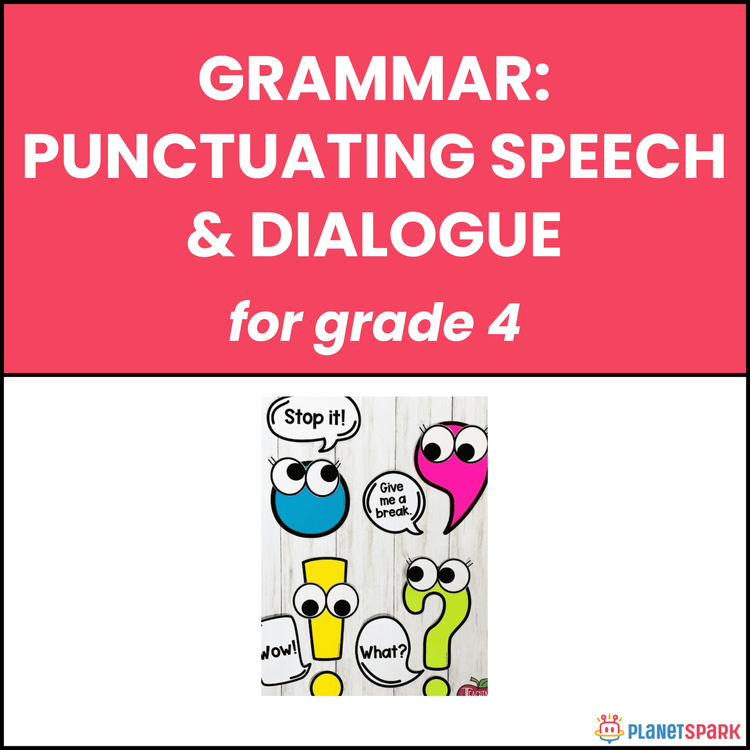
Class 4 Worksheet on Punctuating Speech and Dialogue
Speak with Precision: Punctuating Speech & Dialogue for Grade 4
This Grade 4 grammar worksheet focuses on teaching students how to punctuate speech and dialogue accurately in sentences and longer pieces of writing. As learners move toward structured storytelling and paragraph writing, understanding the correct use of quotation marks, commas, question marks, exclamation marks, and full stops becomes essential.
Through step-by-step and age-appropriate practice, students learn how to punctuate statements, questions, commands, and exclamations within spoken sentences. The worksheet progresses from selecting correctly punctuated dialogue to rewriting sentences and editing a complete speech, helping learners apply punctuation rules confidently in real writing tasks.
Why Punctuating Speech & Dialogue Matters?
Learning to punctuate speech and dialogue helps children:
1. Clearly separate spoken words from narration.
2. Use quotation marks with commas and end punctuation correctly.
3. Read dialogue with proper tone and expression.
4. Write organised and meaningful conversations in stories and answers.
What’s Inside This Worksheet?
This worksheet includes five grammar-rich activities:
Exercise 1 – Choose the Correct Sentence
Students choose the sentence that shows correct punctuation for speech and dialogue.
Exercise 2 – True or False
Learners identify whether punctuation in speech sentences is used correctly.
Exercise 3 – Add Correct Punctuation
Students add quotation marks and correct punctuation to complete each sentence.
Exercise 4 – Rewrite Using Correct Punctuation
Children rewrite sentences neatly using correct punctuation for speech.
Exercise 5 – Speech Editing
Students punctuate a short speech on practising punctuating speech and dialogue.
ANSWER KEY
Exercise 1 – Choose the Correct Sentence
1. a
2. b
3. a
4. b
5. b
6. a
7. c
8. a
9. c
10. a
Exercise 2 – True or False
1. False
2. False
3. True
4. True
5. False
6. True
7. False
8. True
9. False
10. False
Exercise 3 – Add Correct Punctuation
1. Heena asked, “Why is the bus late?”
2. “Please drive slowly,” said Vivan.
3. Risha said, “Can you do this?”
4. Aarush asked, “Is this the job?”
5. “Can we bring more chairs?” asked Heena.
6. Devansh said, “Please clean the room.”
7. “Where is the booster?” asked Zara.
8. Nadiya said, “I can’t find my medal.”
9. “Will you pack the stuff now?” asked Avant.
Exercise 4 – Rewrite Using Correct Punctuation
1. “I forgot my art book,” Tara said.
2. “Don’t touch that!” shouted Nila.
3. “Please pass the glue,” Farhan said.
4. “Can we start the project now?” Vikram asked.
5. “Where is my paintbrush?” Pooja asked.
6. “I think I lost my folder,” Rohan said.
7. “Don’t make a sound,” whispered Kavya.
8. “Let’s finish this later,” Imran said.
9. “Did you see my notebook?” Leela asked.
10. “I love making crafts,” Zoya said.
Exercise 5 – Speech Editing
“Good morning, respected teachers and my dear friends.
Today, I am going to speak about practising punctuating speech and dialogue.
Punctuation is important in writing. It helps us understand sentences clearly. Without punctuation, writing becomes confusing.
Dialogue shows what people say in stories. Punctuation helps us know who is speaking and what is being said. It makes conversations easy to read.
When we practise punctuating speech, our writing becomes neat, clear, and meaningful. It helps us write better stories and answers.
We can practise by reading storybooks, writing short dialogues, and checking our work.
So, let us practise punctuating speech every day.
Thank you for listening.”
Help your child write clear and confident dialogue by mastering speech punctuation rules.
Frequently Asked Questions
They must combine quotation marks, commas, and capital letters correctly.
It separates the speech tag from the spoken words.
Question marks and exclamation marks go inside the quotation marks.