
Class 3 Worksheet on Apostrophes and Possession

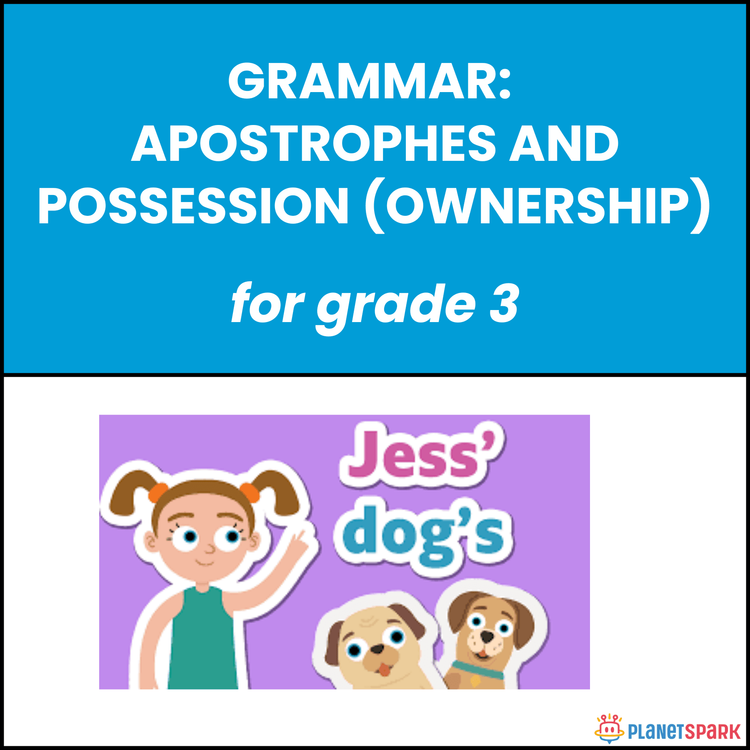
Class 3 Worksheet on Apostrophes and Possession
Show Ownership Clearly: Apostrophes and Possession for Grade 3
This Grade 3 grammar worksheet helps learners understand how apostrophes are used to show possession or ownership. Through simple, relatable examples, children learn that apostrophes help explain who owns something—whether it belongs to one person, more than one person, or even animals.
With a clear progression from identifying correct sentences to rewriting and paragraph-level practice, this worksheet strengthens accuracy and confidence in punctuation. The activities are carefully designed to reduce common mistakes and help students apply apostrophes correctly in everyday writing.
Why Apostrophes Matter in Grammar?
Learning apostrophes for possession helps children:
1. Clearly show ownership in sentences.
2. Avoid confusion between plural nouns and possessive forms.
3. Improve sentence clarity and grammar accuracy.
4. Build strong foundations for descriptive and narrative writing.
What’s Inside This Worksheet?
This worksheet includes five structured grammar activities:
Exercise 1 – Choose the Correct Sentence
Students select the sentence that correctly uses apostrophes for possession.
Exercise 2 – True or False
Learners check whether apostrophes are used correctly.
Exercise 3 – Add Apostrophes
Children add correct possessive apostrophes in given sentences.
Exercise 4 – Rewrite Using Correct Apostrophes
Students rewrite sentences neatly with accurate apostrophe placement.
Exercise 5 – Passage Editing
A short passage where learners add possessive apostrophes throughout the text.
ANSWER KEY
Exercise 1 – Choose the Correct Sentence
1. a
2. b
3. a
4. c
5. a
6. a
7. b
8. b
9. c
10. a
Exercise 2 – True or False
1. True
2. True
3. True
4. False
5. False
6. False
7. False
8. True
9. True
10. True
Exercise 3 – Add Correct Apostrophes
1. Kabir said, “This is my friend’s bag.”
2. “This is the principal’s desk,” said Sana.
3. Arav said, “Have you seen Balu’s pen?”
4. Sana asked, “Is this Rita’s book?”
5. “This is my brother’s lunchbox,” said Riya.
6. Dev said, “This is our team’s project.”
7. Leela asked, “Where is Julie’s bag?”
8. “Can you bring Nina’s notebook?” asked Arav.
9. “Is this Asha’s seat?” asked Asha.
10. Tara asked, “Is this Vishal’s pencil?”
Exercise 4 – Rewrite Using Correct Apostrophes
1. This is Riya’s book.
2. Meena’s bag is on the table.
3. The boys’ shoes are dirty.
4. The dog’s tail is very long.
5. Mom’s cooking smells yummy.
6. Dad’s car is very fast.
7. The cat’s food is in the bowl.
8. The teacher’s desk is clean.
9. Rah’s toys are under the bed.
10. The baby’s bottle is on the chair.
Exercise 5 – Passage Editing
Nina and her brother Max were exploring their grandmother’s house.
Nina picked up her grandmother’s knitting bag and showed Max the colorful yarn inside.
Max held his mother’s umbrella carefully.
They found their father’s old camera in a drawer.
Nina pointed to her brother’s notebook on the table.
Their grandmother called them from the kitchen.
Max grabbed his sister’s apron and put it on.
They noticed their grandmother’s cat sleeping on the sofa.
Help your child master apostrophes for possession and write with clarity and confidence.
Frequently Asked Questions
It shows possession or ownership of an object.
Because both can end with s, but only possessive nouns use an apostrophe.
By practising simple ownership sentences like “Riya’s bag” or “the cat’s tail.”