
Attributive Adjective: Understand the Use of Adjectives in Sentences
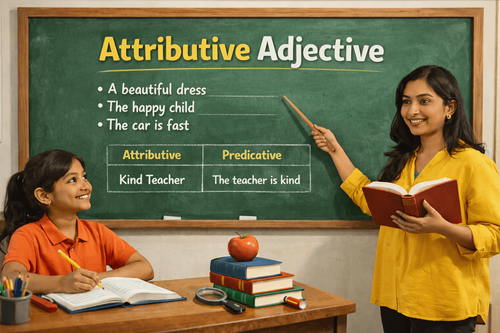

Table of Contents
- What Is an Attributive Adjective?
- Attributive Adjective Examples
- Why Practicing Attributive Adjective Examples Is Important
- Types of Attributive Adjectives
- Attributive and Predicative Adjectives
- Common Mistakes When Using Attributive Adjectives
- Tips to Identify Attributive Adjectives
- How Learning Grammar Improves Communication
- Why Choose PlanetSpark for Learning English
- Conclusion
Adjectives make sentences more descriptive and meaningful. One important type is the attributive adjective, which appears directly before the noun it describes. Understanding how an attributive adjective works helps improve grammar and sentence clarity.
In this guide, you will learn what is attributive adjective, explore attributive adjective examples, and understand the difference between attributive and predicative adjectives with simple explanations and examples.
What Is an Attributive Adjective?
An attributive adjective is an adjective that appears before the noun it describes.
It provides information about the noun directly in the sentence.
Example Sentences
She bought a beautiful dress.
They live in a small house.
He adopted a friendly dog.
In each sentence:
beautiful describes dress
small describes house
friendly describes dog
Because these adjectives appear before the noun, they are called attributive adjectives.

Attributive Adjective Examples
Understanding attributive adjective examples is one of the best ways to learn how these adjectives function in sentences. An attributive adjective appears before the noun and directly describes it. These adjectives add detail, making sentences clearer and more descriptive.
When you use attributive adjectives correctly, your writing becomes more vivid and engaging because readers can easily visualize the noun being described.
Below are several attributive adjective examples in different types of sentences.
Simple Attributive Adjective Examples
These examples show the most basic structure of attributive adjectives.
She bought a beautiful dress.
We saw a bright rainbow in the sky.
He adopted a friendly dog from the shelter.
They visited an ancient temple during their trip.
She lives in a small apartment near the city center.
In each sentence, the adjective comes before the noun and provides more information about it.
Attributive Adjectives in Everyday Sentences
Attributive adjectives are commonly used in daily conversations and writing.
Examples include:
The blue sky looked beautiful after the rain.
She prepared a delicious meal for her family.
He bought a new laptop for his work.
They watched an interesting movie last night.
We visited a peaceful village during our vacation.
These sentences show how attributive adjectives help describe objects, places, and experiences more clearly.
Attributive Adjectives Describing People
Attributive adjectives are also used to describe people and their qualities.
Examples include:
She is a kind teacher who helps every student.
He met a talented artist at the exhibition.
They hired a skilled engineer for the project.
The young athlete won the competition.
We spoke to a helpful assistant at the office.
In these examples, the adjectives describe qualities or characteristics of people.
Multiple Attributive Adjectives in a Sentence
Sometimes more than one attributive adjective can appear before a noun.
Examples include:
She bought a beautiful red dress.
They live in a large modern house.
He adopted a small brown puppy.
We visited an old historic building.
She carried a heavy black bag.
When multiple adjectives are used, they usually follow a specific adjective order to sound natural.
Attributive Adjective Examples in Questions
Attributive adjectives can also appear in questions.
Examples include:
Did you read the interesting book I recommended?
Have you seen the new restaurant in the city?
Who owns that beautiful house near the park?
Did she buy the blue car we saw yesterday?
These examples show how attributive adjectives appear naturally in both statements and questions.
Why Practicing Attributive Adjective Examples Is Important
Practicing attributive adjective examples helps learners understand how adjectives function in real sentences. When students regularly practice identifying and using these adjectives, they improve their grammar, writing clarity, and communication skills.
Using attributive adjectives correctly helps writers:
Add detail to sentences
Make descriptions more vivid
Improve sentence structure
Express ideas more clearly
With practice, learners can confidently use attributive adjectives in both spoken and written English.
Want to improve your English grammar and sentence structure? Book a free demo trial with PlanetSpark and learn English through interactive lessons and expert guidance.
Types of Attributive Adjectives
Different types of adjectives can function as attributive adjectives.
Descriptive Adjectives
Describe qualities or characteristics.
Examples:
a happy child
a tall building
a delicious meal
Quantitative Adjectives
Describe quantity or amount.
Examples:
many students
several books
few opportunities
Demonstrative Adjectives
Point to specific nouns.
Examples:
this car
that house
these flowers
Attributive and Predicative Adjectives
Understanding attributive and predicative adjectives helps clarify how adjectives function in sentences.
Attributive Adjective
Appears before the noun.
Example:
She has a kind teacher.
Predicative Adjective
Appears after a linking verb such as is, are, seems, becomes.
Example:
The teacher is kind.
Comparison Table
| Attributive Adjective | Predicative Adjective |
|---|---|
| Comes before noun | Comes after linking verb |
| Describes noun directly | Describes subject through verb |
| Example: a happy child | Example: the child is happy |
Both forms describe nouns, but their position in the sentence is different, and English grammar also uses other structures that add descriptive information to nouns.

Why Attributive Adjectives Are Important
Using attributive adjectives correctly improves sentence clarity and writing quality.
They help writers:
Provide more information about nouns
Improve storytelling and writing skills
Create clearer communication
For example:
Instead of writing:
She bought a dress.
You can write:
She bought a beautiful dress.
The adjective adds detail and meaning to the sentence.
Common Mistakes When Using Attributive Adjectives
Learners sometimes make mistakes when using attributive adjectives.
Incorrect Word Order
Wrong:
She bought a dress beautiful.
Correct:
She bought a beautiful dress.
Using Too Many Adjectives
Example:
a small beautiful old wooden house
Too many adjectives can confuse readers. Keep descriptions clear and simple.
Confusing Attributive and Predicative Forms
Wrong:
The teacher kind.
Correct:
The teacher is kind.
Want to improve your English grammar and sentence structure?
Book a free demo trial with PlanetSpark and learn English through interactive lessons and expert guidance.
Tips to Identify Attributive Adjectives
Here are simple ways to identify an attributive adjective in a sentence.
Look for the Position
If the adjective appears before a noun, it is likely attributive.
Example:
a blue sky
Check the Sentence Meaning
Ask:
“What word describes the noun?”
Example:
The happy child laughed.
The adjective happy describes the noun child.
Practice With Examples
Practicing sentence examples helps learners recognize attributive adjectives quickly.
How Learning Grammar Improves Communication
Strong grammar skills help individuals communicate more clearly and confidently.
Learning concepts such as attributive adjectives helps improve writing skills and strengthens overall grammar understanding:
Writing skills
Sentence structure
Reading comprehension
Spoken English clarity
Grammar knowledge allows learners to create clear and meaningful sentences in both academic and professional environments.
Struggling with grammar concepts like attributive adjectives? Book a free demo trial with PlanetSpark and learn English grammar through interactive lessons and practical examples.
Why Choose PlanetSpark for Learning English
PlanetSpark helps learners improve English grammar, communication, and confidence through structured learning programs.
Key Features of PlanetSpark Programs
Holistic Curriculum Beyond Academics
Focus on communication, critical thinking, and language skills.
Practical Activity-Based Learning
Includes storytelling, presentations, and grammar exercises.
Personalized 1-on-1 Live Sessions
Expert trainers provide personalized attention and guidance.
Flexible Learning Schedule
Convenient class timings make learning easy and accessible.
These features help learners improve grammar and communication skills effectively.
Conclusion
Understanding the attributive adjective helps learners improve grammar and sentence clarity. By learning attributive adjective examples and understanding the difference between attributive and predicative adjectives, students can build stronger writing and communication skills.
With practice and structured learning, grammar concepts become easier to understand and apply in everyday communication.
Frequently Asked Questions
An attributive adjective is an adjective that appears before the noun it describes. It directly modifies the noun in a sentence.
Example: She bought a beautiful dress.
Here, beautiful describes the noun dress, so it is an attributive adjective.
An attributive adjective appears before the noun it describes, while a predicative adjective appears after a linking verb such as is, are, or seems.
Example: a happy child (attributive) and the child is happy (predicative).
Examples of attributive nouns used as adjectives include:
chicken soup
school bus
coffee cup
stone wall
office building
In these examples, the first noun describes the second noun, functioning like an adjective.
The seven common types of adjectives include:
Descriptive adjectives
Quantitative adjectives
Demonstrative adjectives
Possessive adjectives
Interrogative adjectives
Distributive adjectives
Articles (a, an, the)
These adjectives help describe nouns and add more detail to sentences
An attributive adjective is an adjective that appears before the noun it describes in a sentence. It directly modifies the noun and adds more information about it.
Example: She adopted a friendly dog. Here, friendly describes the noun dog, making it an attributive adjective.
PlanetSpark offers structured English learning programs that improve grammar, communication, and confidence.
PlanetSpark provides expert trainers, activity-based learning, and personalized one-on-one sessions that help learners improve grammar, vocabulary, and communication skills effectively.