
Class 5 Worksheet on Settings and Sensory Details

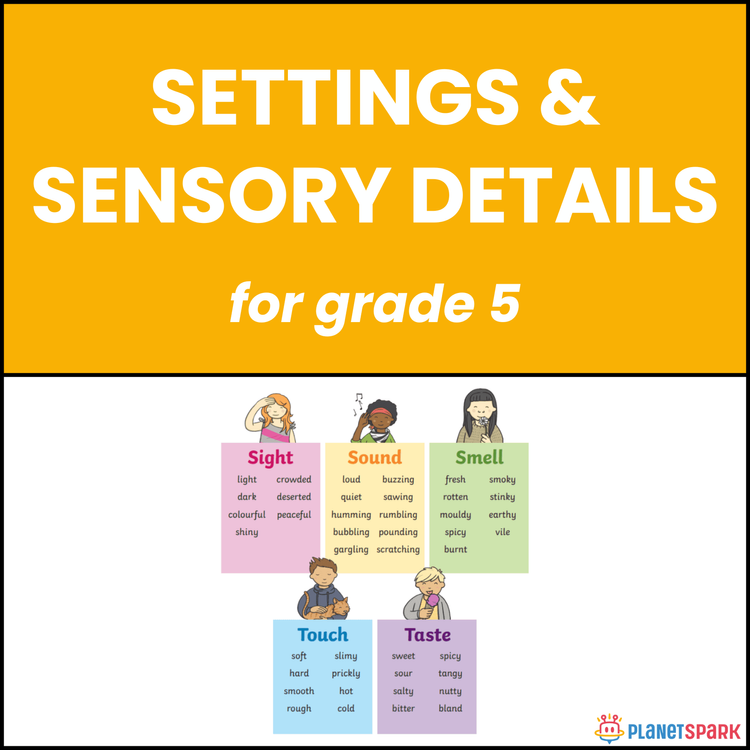
Class 5 Worksheet on Settings and Sensory Details
Write What You See, Hear & Feel: Settings & Sensory Details for Class 5
This Class 5 narrative writing worksheet teaches students how to bring scenes to life using vivid settings and sensory details.
With a model passage on page 3—where Aarav observes the school garden using sight, sound, smell, and touch—learners understand how small descriptive clues create a rich, realistic story world.
The worksheet includes MCQs, short-answer questions with hints, sensory detail rewrites, setting-based description tasks, and sentence transformation exercises.
Students learn to:
• Identify sensory details in a passage
• Strengthen writing using sight, sound, smell, touch, and movement
• Describe settings with clarity and imagery
• Rewrite plain sentences into vivid ones
• Apply sensory language to paragraphs and story scenes
This worksheet builds strong descriptive writing skills and improves overall narrative expression.
------------------------------------
ANSWER KEY (Included for Parents & Teachers)
Exercise 1 – Multiple Choice
1. b) Fresh paint
2. c) Observing the garden
3. a) Hum of traffic
4. c) A nearby classroom
5. b) Leaves moving gently in the wind
Exercise 2 – Short Answers
1. Aarav observed bright marigold flowers, distant traffic, the breeze, and garden movement.
2. The breeze felt cool as it brushed against his arms.
3. The students shared their sensory notes with each other.
4. Synonym for lively: *active*.
5. By using his senses—saw, heard, and felt—his writing became more engaging and realistic.
Exercise 3 – Rewrite with Stronger Sensory Details (Sample answers; may vary)
2. The library was big → Tall shelves towered over me, filled with books that smelled of old paper.
3. The soup was good → The warm soup tasted rich and creamy, filling the room with a savoury aroma.
4. The beach was loud → Waves crashed against the shore as children squealed and gulls screeched overhead.
5. The room smelled odd → A musty, sour smell drifted from the corner like something long forgotten.
6. The rain was strong → Heavy raindrops pounded the roof like drumming fingertips.
7. The bakery was nice → The bakery glowed warmly, and the air was sweet with the smell of fresh bread.
8. The classroom was quiet → Only the soft scratch of pencils broke the stillness.
9. The river was cold → The icy river water nipped at my toes like tiny needles.
10. The festival was fun → Bright lights flickered, music boomed, and the air buzzed with laughter.
Exercise 4 – Setting Description (Samples)
Setting: Rainy Afternoon in the Park
• Sight: Raindrops splashing on puddles; trees swaying; empty swings rocking.
• Sound: Pattering rain, distant thunder, birds chirping softly.
• Smell/Touch: Smell of wet earth; cool mist brushing the skin.
Paragraph Sample:
The park glistened with fresh rain as puddles rippled under falling droplets. The empty swings creaked gently while trees swayed in the cool wind. I could hear the steady patter of rain mixed with a faint rumble of thunder. The air smelled of wet earth, and a cool mist brushed softly against my cheeks, making the whole scene feel peaceful and alive.
Exercise 5 – Add Setting + Sensory Clues (Samples)
1. The girl sat in the garden → The girl sat in the sunlit garden, listening to bees hum around blooming roses.
2. We entered the school hall → We entered the echoing school hall, where the smell of polish lingered.
3. The bus stopped on the road → The bus screeched to a halt on the dusty road as smoke puffed from behind it.
4. The boys played in the field → The boys played in the muddy field, shouting joyfully as the wind whipped past them.
5. He opened the old door → He opened the old wooden door, which groaned and released a puff of dusty air.
6. The cat slept on the sofa → The cat slept curled on the soft sofa, purring as warm sunlight covered her fur.
7. They walked through the market → They walked through the crowded market filled with chatter and the smell of spices.
8. The teacher wrote on the board → The teacher wrote swiftly on the board, chalk dust drifting into the quiet room.
9. The family ate dinner together → The family ate dinner together, the aroma of warm rotis filling the cosy kitchen.
10. The festival was fun → The festival sparkled with lights and music as laughter floated through the night air.
------------------------------------
Help your child turn simple sentences into vivid scenes with the power of sensory language!
Transform your child’s narrative writing skills with guided sensory detail practice—start today!
🔖Book a free trial!
Frequently Asked Questions
Sensory details help students describe what characters see, hear, smell, taste, and feel, making scenes more vivid for readers.
A well-defined setting provides context for the plot and helps readers visualize where and when the events are taking place.
Many students focus on events instead of description, so practice with guided prompts helps them notice specific details.